SpaceX Falcon 9 Booster B1067 Shatters Its Own Record with 33rd Successful Flight
The fleet leader just raised the bar — again — for what reusable rocketry can achieve.
⚡ 30-Second Brief
The News: SpaceX Falcon 9 booster B1067 successfully launched and landed for a record-breaking 33rd time, deploying 28 Starlink satellites from Florida on February 22, 2026.
Why It Matters: Every additional reuse of a booster slashes the cost of putting satellites into orbit — including the Starlink constellation that beams internet to Tesla vehicles globally.
Sources: @NASASpaceflight · @SpaceX

📊 Key Figures
| Metric | Value | Context |
|---|---|---|
| Booster | B1067 | Falcon 9 fleet leader |
| Record Flight | 33rd | Previous record: 32 (B1067, Dec 8, 2025) |
| Payload | 28 Starlink v2-mini satellites | Mission: Starlink 6-104 |
| Launch Site | SLC-40, Cape Canaveral, Florida | Space Force Station |
| Landing Ship | A Shortfall Of Gravitas (ASOG) | Autonomous drone ship, Atlantic Ocean |
| Turnaround Time | 75 days | From B1067's previous mission |
| SpaceX Reuse Goal | Up to 40 flights | Certification target per booster |

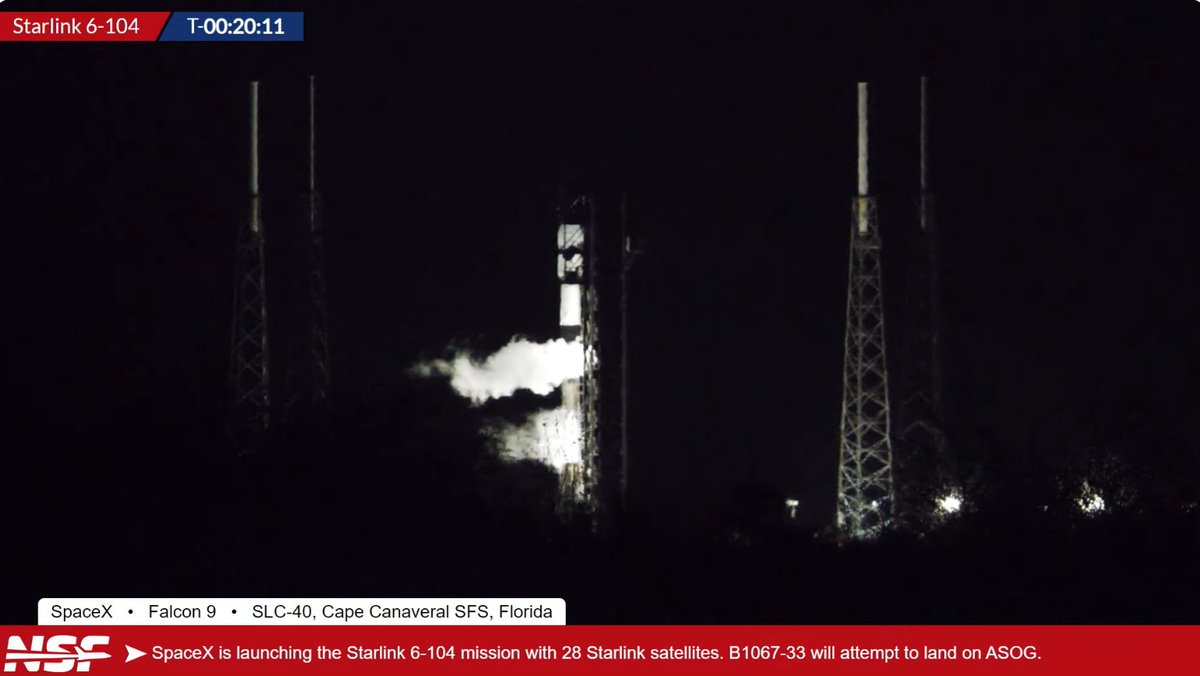
NSF captured B1067 in the final countdown window, with the characteristic pre-launch vent visible — a routine that this particular booster has now completed 33 times.


🔭 The BASENOR Take
Timeline
February 22, 2026 — 03:48 UTC
Impact Level
🟢 High — Industry-defining
Confidence
✅ Confirmed — Multiple primary sources
📰 Deep Dive
Booster B1067 has now flown more times than any rocket booster in history. When SpaceX retired the Space Shuttle, a single orbiter might fly 30+ missions over decades — B1067 just matched and exceeded that pace in roughly four years of service, with a 75-day turnaround between its 32nd and 33rd flights. That is not an incremental improvement; it is a fundamental restructuring of what launch economics look like.
The significance for Starlink — and by extension, Tesla owners who rely on Starlink connectivity — is compounding. Each reuse of B1067 reduces the marginal cost of deploying additional satellites. The 28 Starlink v2-mini satellites aboard Starlink 6-104 contribute to a constellation that now underpins Tesla's in-car connectivity, over-the-air software updates, and the broader SpaceX internet business. A lower launch cost means SpaceX can deploy coverage faster and at higher density, improving service quality globally.
SpaceX has publicly stated its goal of certifying Falcon 9 boosters for up to 40 flights per vehicle. B1067 is now seven flights away from that target. If the booster continues at its current turnaround cadence, it could realistically reach the 40-flight mark before the end of 2026. Every flight between here and that certification threshold is data — stress cycles on the engines, heat shield wear patterns, avionics reliability — that feeds directly into SpaceX's understanding of how far reusability can be pushed, both on Falcon 9 and on the far more ambitious Starship program.
For the broader space industry, tonight's landing on A Shortfall Of Gravitas is a quiet but decisive proof point: the question is no longer whether rocket boosters can be reused dozens of times, but how cheaply and how reliably the industry can scale that capability. B1067 is making the answer very clear.
Sources & reporting notes
The links below identify the material source records used for this report.
- @NASASpaceflight on X (2026-02-22T03:56:23.000Z) — Direct source
- @NASASpaceflight on X (2026-02-22T03:50:56.000Z) — Direct source
- @NASASpaceflight on X (2026-02-22T03:48:23.000Z) — Direct source
- @NASASpaceflight on X (2026-02-22T03:27:54.000Z) — Direct source
- @SpaceX on X (2026-02-22T03:40:18.000Z) — Direct source
Source links are preserved as published or accessed. See our editorial standards and corrections policy.
The BASENOR Editorial Desk covers Tesla, SpaceX, and related technology, curating reporting from primary sources — official accounts, regulatory filings, and software release data. Every article passes source-record and fact-checking review before publication. About the newsroom.
This report was curated by the BASENOR Editorial Desk from the sources listed above. Read our editorial standards or email editorial@basenor.com to report an error.