📌 UPDATE — October 20, 2026
SpaceX has confirmed that the rideshare deployment sequence for Bandwagon-5 has begun, with the 32 payloads now being released into their designated orbits. The announcement came via SpaceX's official X account at 12:01 UTC, roughly an hour after liftoff. This marks the mission's critical final phase, as each of the smallsat customers aboard will receive their spacecraft into orbit over the coming deployment window.
🐦 @SpaceX · Oct 20, 2026
"Rideshare deployment sequence has started"
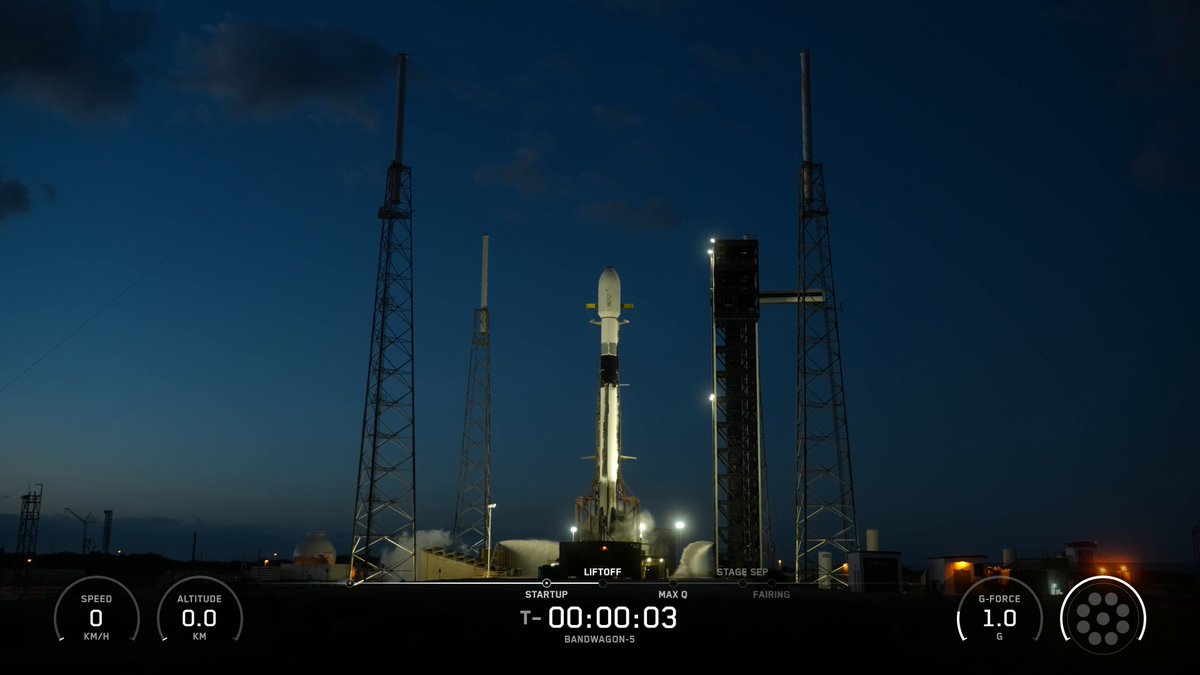
SpaceX added another chapter to its reusability record on Tuesday morning, launching the Bandwagon-5 rideshare mission from Cape Canaveral and recovering the Falcon 9 first stage on the Atlantic droneship A Shortfall of Gravitas. The booster, tail number B1085, flew for the 19th time — one of the most-flown rockets in the active Falcon 9 fleet.
Liftoff occurred at 7:04 a.m. EDT (1104 GMT) from the Space Force Station in Florida, with the first stage touching down roughly nine minutes later, according to space.com and SpaceX's own mission timeline.

What flew on Bandwagon-5
Bandwagon-5 is the fifth flight in SpaceX's dedicated mid-inclination rideshare program, which complements the sun-synchronous Transporter missions. According to the Sunday Guardian and space.com, the manifest included 32 payloads spanning government, commercial, and research customers. Among them is a "Starfall" return capsule — an in-space-manufacturing-style demonstrator designed to re-enter Earth's atmosphere with its payload intact, a capability that is quickly becoming a competitive front in commercial space.
Rideshare missions like Bandwagon are increasingly how smaller operators get to useful orbits without buying a dedicated launch. For SpaceX, they also keep Florida pads busy between Starlink deployments and crewed flights.
Booster B1085's 19-flight résumé
The star of the morning was B1085, which has quietly become one of the workhorses of the fleet. Per published mission records, its earlier flights include NASA's Crew-9 mission, the RRT-1 rapid response tanker demonstration, Firefly's Blue Ghost Mission 1 lunar lander launch, Fram2, SXM-10 for SiriusXM, MTG-S1 for EUMETSAT, EchoStar XXV, and ten Starlink deployments.
That mix — a crewed Dragon, a lunar lander ride, a geostationary weather satellite, direct-to-cell infrastructure, and routine Starlink hauling — illustrates how far SpaceX has pushed single-booster reuse. When Falcon 9 first landed in 2015, SpaceX's internal design target for each core was ten flights. B1085 is now nearly double that.

Key figures
| Metric | Value |
|---|---|
| Mission | Bandwagon-5 rideshare |
| Liftoff | 7:04 a.m. EDT, Oct 20, 2026 |
| Launch site | Cape Canaveral SFS, Florida |
| Booster | B1085 (19th flight) |
| Recovery | A Shortfall of Gravitas droneship, Atlantic |
| Payload count | 32, including a Starfall return capsule |
Why this matters beyond another successful launch
Every additional flight on a core like B1085 compresses SpaceX's effective cost per kilogram and extends the data record it uses to justify ever-longer life extensions with the FAA and its customers. Crew flights still ride on relatively low-flight-count boosters, but commercial and government payload operators have grown comfortable with high-flight cores — a cultural shift that would have been hard to imagine when SpaceX first proposed reflying stages.
The cadence story is equally relevant. NASASpaceflight, which covered both the liftoff and the booster return in real time, has tracked Falcon 9 maintaining a flight rate that no other orbital-class vehicle currently approaches. That cadence is what makes rideshare programs like Bandwagon economically viable: operators know a slot is likely to open on a predictable schedule rather than slipping by quarters.

What to watch next
- Starfall capsule reentry: If the return capsule performs its reentry and recovery as designed, it adds another competitor to the small but growing in-space-return market.
- B1085's 20th flight: SpaceX has not publicly set a hard ceiling on individual core reuse. The next assignment for B1085 will show whether the company is comfortable pushing into the 20s on commercial manifests.
- Bandwagon-6 manifest: With Bandwagon-5 away, attention shifts to the next mid-inclination rideshare slot and which smallsat operators secure capacity.
- Range turnaround: Cape Canaveral and Kennedy are juggling Falcon 9, Falcon Heavy, and increasing commercial activity. Watch how quickly SLC-40 is reconfigured for the next flight.
Mini-FAQ
Was anyone on board Bandwagon-5?
No. Bandwagon-5 is an uncrewed rideshare mission carrying 32 satellite and capsule payloads for commercial, government, and research customers.
How many times has booster B1085 flown now?
Bandwagon-5 was its 19th flight. Previous missions include Crew-9, RRT-1, Firefly Blue Ghost Mission 1, Fram2, SXM-10, MTG-S1, EchoStar XXV, and ten Starlink deployments.
Why land on a droneship instead of back at Cape Canaveral?
Return-to-launch-site landings require extra propellant for a boostback burn. For higher-energy trajectories like Bandwagon's mid-inclination orbit, landing downrange on A Shortfall of Gravitas preserves performance margin for the payloads.
What is the Starfall capsule?
Based on publicly available descriptions, Starfall is a return capsule designed to bring payloads back from orbit through a controlled reentry — the kind of capability useful for in-space manufacturing samples, biotech experiments, and secure cargo return.
What is the current Falcon 9 reuse record?
SpaceX has not officially capped core reuse, and multiple boosters are now in the high teens. B1085's 19th flight puts it among the leaders, though the all-time record continues to be reset as cores are cleared for additional missions.
For the SpaceX program as a whole, missions like this one have become almost routine — and that is precisely the point. The headline isn't that Falcon 9 flew and landed. It's that the company can book a 19-flight core on a 32-payload rideshare and treat it as a Tuesday morning.
Sources & reporting notes
The links below identify the material source records used for this report.
- @SpaceX on X (2026-10-20T11:04:46.000Z) — Direct source
- @NASASpaceflight on X (2026-10-20T11:05:02.000Z) — Direct source
- @SpaceX on X (2026-10-20T11:13:49.000Z) — Direct source
- @NASASpaceflight on X (2026-10-20T11:16:02.000Z) — Direct source
Source links are preserved as published or accessed. See our editorial standards and corrections policy.
The BASENOR Editorial Desk covers Tesla, SpaceX, and related technology, curating reporting from primary sources — official accounts, regulatory filings, and software release data. Every article passes source-record and fact-checking review before publication. About the newsroom.
This report was curated by the BASENOR Editorial Desk from the sources listed above. Read our editorial standards or email editorial@basenor.com to report an error.