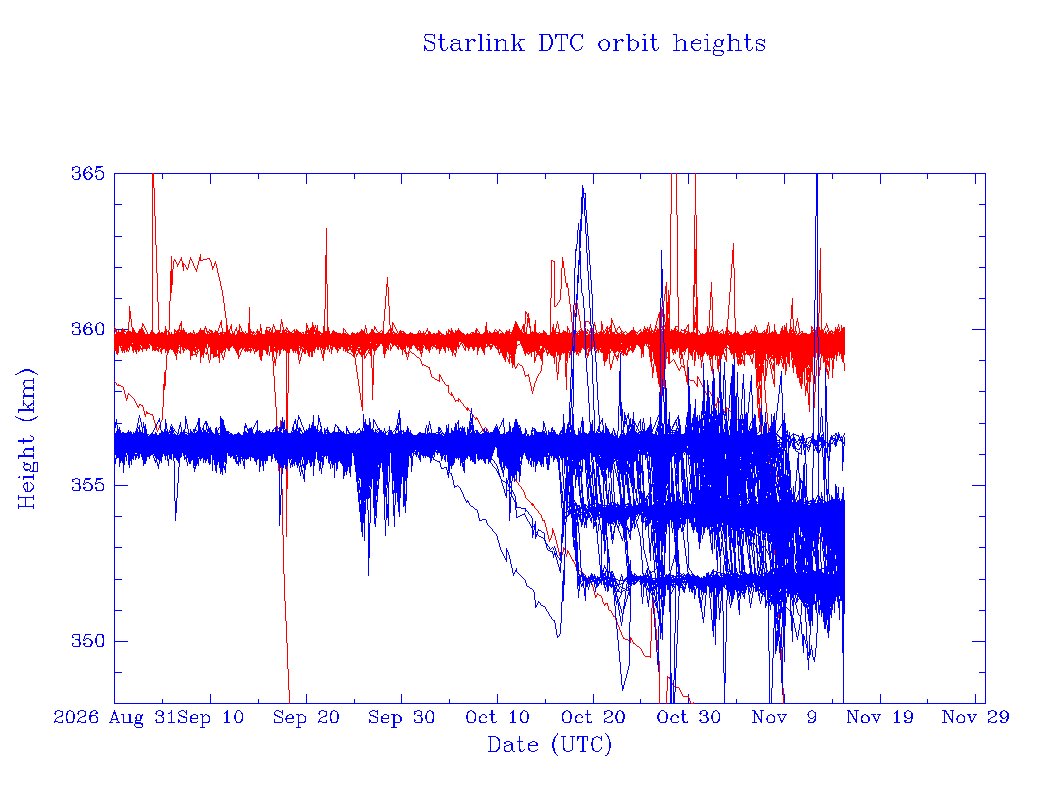
SpaceX is actively reconfiguring the orbital altitudes of its Starlink constellation across multiple shells — and the scale of the operation is becoming clearer. Astronomer Jonathan McDowell flagged the latest development on November 15: the 43-degree Direct-to-Cell (DTC) Starlinks, previously holding at 356 km, are now drifting down to 352 and 354.5 km. Meanwhile, the broader lowering of the 550 km shell — a much larger operation involving roughly 4,400 satellites — continues in parallel.

Two Separate Maneuvers, One Strategic Direction
The 550 km shell lowering is the headline operation. According to SpaceX Vice President of Starlink Engineering Michael Nicolls, the company is bringing those satellites down to approximately 480 km — a drop of roughly 70 km. The stated reasons are straightforward: reduce the probability of collisions and dramatically cut the time it takes for defunct satellites to reenter the atmosphere. At 550 km, a dead satellite can linger for over four years during solar minimum. At 480 km, that window shrinks to a matter of months. With approximately 9,815 active Starlink satellites in orbit as of mid-November, the debris calculus matters enormously.
The 43-degree DTC shell adjustment is smaller in magnitude — a few kilometers — but notable because it signals that SpaceX is fine-tuning even its newer, more specialized Direct-to-Cell infrastructure. DTC satellites are the ones designed to connect directly to standard smartphones without any ground hardware, a capability SpaceX has been rolling out through carrier partnerships. The 43-degree inclination gives these satellites coverage optimized for mid-latitude population centers. A shift from 356 km to the 352–354.5 km range is subtle, but it suggests active management rather than passive station-keeping.
Notably, McDowell points out that the 53-degree DTC Starlinks at 360 km have not moved. That divergence is worth watching — it may reflect different operational priorities between the two DTC orbital planes, or simply that the 53-degree shell is still in an earlier phase of whatever reconfiguration SpaceX has planned.
The Safety and Coordination Dimension
The 550 km lowering didn't happen in a vacuum. It followed an anomaly on Starlink satellite 35956 in December 2025, which generated a small debris field at 418 km. That incident, minor by most measures, appears to have accelerated SpaceX's timeline for getting its highest-density shell to a lower, faster-decaying altitude. The operation is being coordinated with US Space Command, regulators, and other orbital operators — a level of interagency involvement that reflects how seriously the industry now treats conjunction risk at crowded altitudes.
For context on the scale: moving ~4,400 satellites from 550 km to 480 km is not a single command. It's a phased campaign of propulsive maneuvers spread across 2026, requiring careful sequencing to avoid creating transient traffic conflicts during the transition itself. The fact that it's happening concurrently with DTC shell adjustments underscores how much active orbital management SpaceX now runs as a routine operation.
What Lower Orbits Mean for Service
There's a user-facing upside buried in the safety rationale. Lower orbital altitude means a shorter round-trip distance for signals, which translates directly to reduced latency. Starlink already competes favorably on latency against geostationary broadband, and a move from 550 km to 480 km should tighten that advantage further. For DTC users on smartphones, even marginal improvements in link reliability at 352 km versus 356 km could matter in marginal coverage scenarios — the physics of path loss favor the lower orbit.
McDowell's tracking data offers a rare ground-level view into an operation that SpaceX manages largely without public commentary. The constellation is not static — it's an actively managed system, and the orbital altitudes published in regulatory filings are increasingly treated as starting points rather than fixed parameters. Whether the 53-degree DTC shell eventually follows the 43-degree group downward will be one of the cleaner signals of where SpaceX's long-term DTC architecture is headed. For more on SpaceX's evolving constellation strategy, see our SpaceX coverage.
Sources & reporting notes
The links below identify the material source records used for this report.
- @planet4589 on X (2026-11-15T21:31:19.000Z) — Direct source
Source links are preserved as published or accessed. See our editorial standards and corrections policy.
The BASENOR Editorial Desk covers Tesla, SpaceX, and related technology, curating reporting from primary sources — official accounts, regulatory filings, and software release data. Every article passes source-record and fact-checking review before publication. About the newsroom.
This report was curated by the BASENOR Editorial Desk from the sources listed above. Read our editorial standards or email editorial@basenor.com to report an error.