30-Second Brief
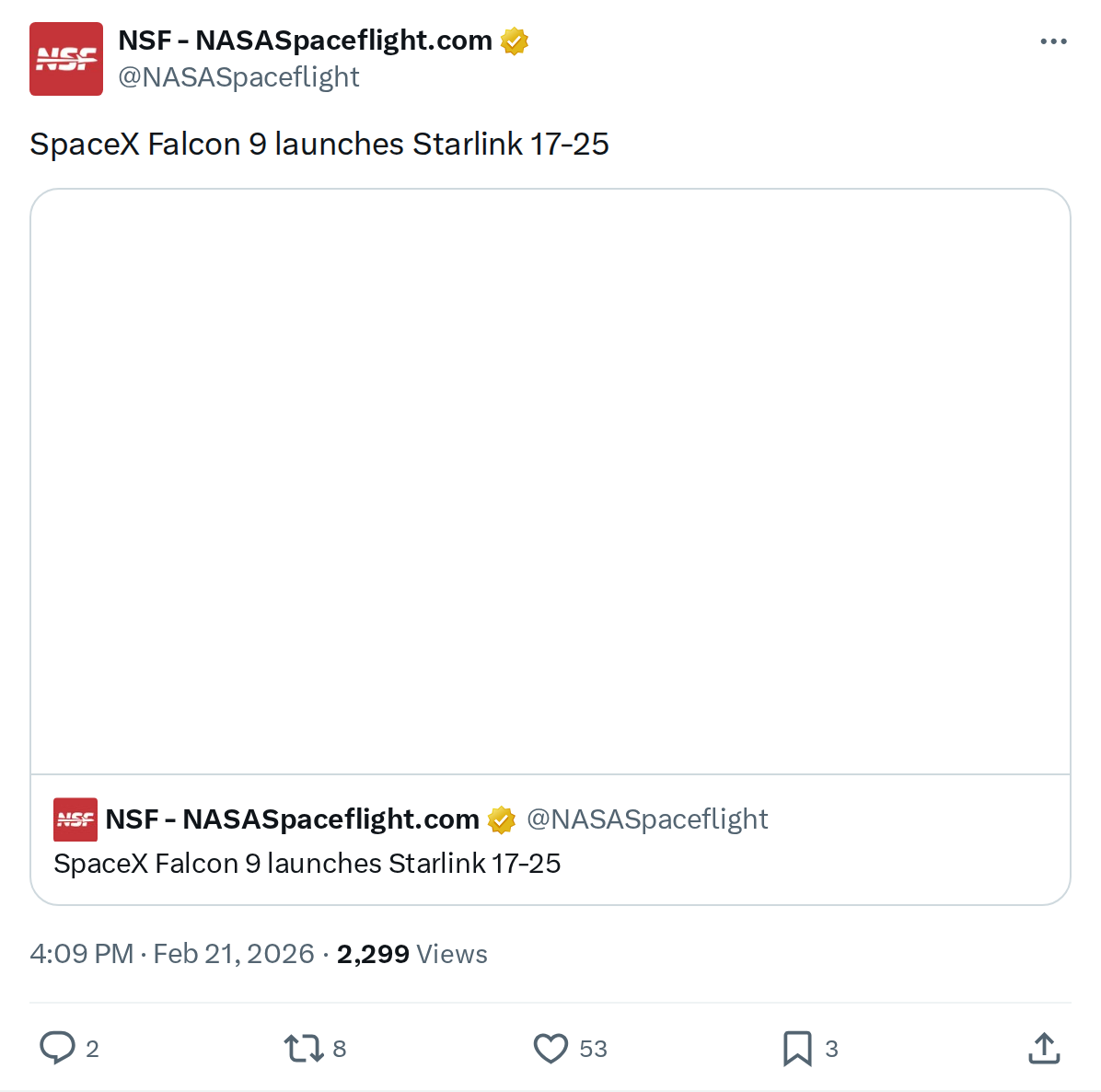
The News: SpaceX has successfully launched a Falcon 9 rocket carrying 25 Starlink satellites to low-Earth orbit from Vandenberg Space Force Base in California.
Why It Matters: Every Starlink launch expands the constellation that powers Tesla's in-car connectivity and Premium Connectivity — more satellites means more coverage, better performance, and a stronger backbone for features that Tesla owners rely on daily.
Sources: @SpaceX · @NASASpaceflight
SpaceX Launches 25 Starlink Satellites from Vandenberg — Falcon 9 Booster Hits 31st Flight
Published February 21, 2026 · SpaceX
SpaceX has once again demonstrated its relentless launch cadence, sending 25 new Starlink satellites into low-Earth orbit this morning from Space Launch Complex 4 East (SLC-4E) at Vandenberg Space Force Base in California. The Falcon 9 rocket lifted off in the early hours of February 21, 2026, continuing the steady drumbeat of missions that have built Starlink into the world's largest satellite internet constellation.

📊 Key Figures
| Metric | Detail |
|---|---|
| Satellites Deployed | 25 (Starlink Group 17-25) |
| Launch Vehicle | Falcon 9 |
| Launch Site | SLC-4E, Vandenberg Space Force Base, California |
| Booster Flight Number | 31st flight of this first-stage booster |
| Booster Landing Zone | 'Of Course I Still Love You' droneship, Pacific Ocean |
| Launch Date (UTC) | February 21, 2026 |

🔭 The BASENOR Take
| Timeline | Ongoing — launches are now routine every few weeks |
| Impact Level | Medium — cumulative gains compound over time |
| Confidence | High — confirmed by both @SpaceX and @NASASpaceflight |
📰 Deep Dive
The Starlink 17-25 mission is another data point in one of the most ambitious infrastructure buildouts in modern history. With a Falcon 9 first-stage booster completing its 31st flight — landing on the 'Of Course I Still Love You' droneship in the Pacific — this mission also underscores how thoroughly SpaceX has industrialized rocket reuse. A year ago, a 31-flight booster would have been unthinkable; today it's routine.
For Tesla owners specifically, the Starlink connection is direct. Tesla's Premium Connectivity relies on cellular networks, but SpaceX and Tesla share a common parent in Elon Musk's portfolio of companies. A larger, denser Starlink constellation strengthens the case for future Tesla vehicles using direct satellite backup connectivity — a capability that has been discussed as a long-term possibility for vehicles in areas with poor cellular coverage. Every satellite added to the constellation moves that vision closer to reality.
Beyond Tesla, the scale of these launches has tangible effects on the global internet landscape. Starlink is now a significant provider of high-speed broadband in underserved and rural regions across dozens of countries, and each new batch of satellites reduces latency and increases total network capacity. The consistency of SpaceX's launch cadence — fueled by the reusability of the Falcon 9 — is what makes all of this possible. A booster flying its 31st mission is not just an engineering milestone; it's the economic engine that keeps ticket prices low and launch frequency high.
What to watch next: whether any future Tesla over-the-air update roadmap references Starlink-based connectivity as a fallback option for Full Self-Driving telemetry or software updates in low-coverage zones. The infrastructure is being built; the software integration is the next frontier.
Sources & reporting notes
The links below identify the material source records used for this report.
- @SpaceX on X (2026-02-21T08:57:42.000Z) — Direct source
- @NASASpaceflight on X (2026-02-21T08:09:14.000Z) — Direct source
Source links are preserved as published or accessed. See our editorial standards and corrections policy.
The BASENOR Editorial Desk covers Tesla, SpaceX, and related technology, curating reporting from primary sources — official accounts, regulatory filings, and software release data. Every article passes source-record and fact-checking review before publication. About the newsroom.
This report was curated by the BASENOR Editorial Desk from the sources listed above. Read our editorial standards or email editorial@basenor.com to report an error.