30-Second Brief
The News: Reports are surfacing about SpaceX developing dedicated 'harvester' systems designed to extract resources — including propellant and oxygen — directly from the lunar surface to support a permanent human presence on the Moon.
Why It Matters: If SpaceX can produce fuel on the Moon itself, Starship missions become dramatically cheaper and more sustainable — this is the foundational technology required for Elon Musk's stated goal of a self-sustaining lunar city within a decade.
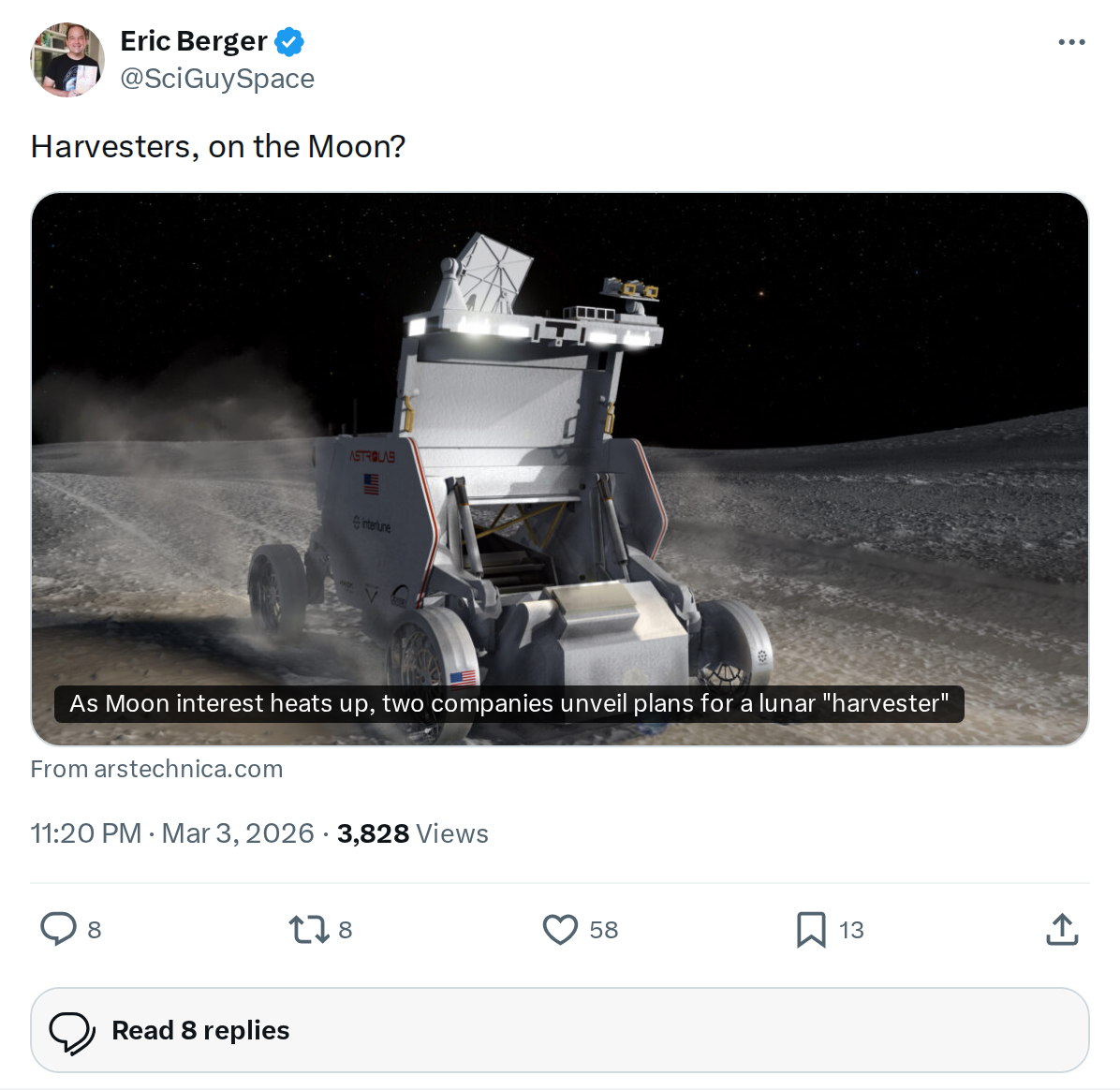
Source: @SciGuySpace on X
SpaceX Lunar Harvesters: The Infrastructure Behind a Permanent Moon City
The concept just moved a step closer to reality. Eric Berger — one of the most plugged-in space journalists covering SpaceX — flagged a significant development today: 'harvesters' designed for the lunar surface. It's a single word that carries enormous weight for the future of deep space exploration.

📊 Key Figures
| Metric | Value | Context |
|---|---|---|
| Starship HLS cargo capacity | 100+ metric tons | Per lunar surface mission |
| First orbital refueling demo | 2026 (target) | Ship-to-ship propellant transfer |
| Uncrewed HLS lunar demo | June 2027 | Precedes Artemis III crewed landing |
| Artemis III crewed landing | 2028 | Rescheduled from Sept 2026 |
| SpaceX lunar city timeline | < 10 years | Musk announced Feb 2026 |
What Is a Lunar Harvester?
In the context of In-Situ Resource Utilization (ISRU), a 'harvester' refers to equipment designed to extract and process raw materials found on the lunar surface — without shipping those materials from Earth. On the Moon, the most valuable targets are:
- Water ice — concentrated in permanently shadowed craters near the lunar south pole. Electrolysis can split it into hydrogen and oxygen, which are the exact propellants Starship runs on.
- Oxygen locked in regolith — the lunar soil contains oxygen chemically bound in rock and minerals. Extracting it requires energy-intensive industrial processes, but the raw material is abundant.
- Metals and silicates — useful for in-situ manufacturing of hardware, habitats, and — per SpaceX's own stated vision — satellite components.
The core logic is straightforward: every kilogram of propellant you can produce on the Moon is a kilogram you don't have to launch from Earth. At Starship's scale, that math becomes transformational.
Why This Is the Linchpin of SpaceX's Lunar Ambitions
In February 2026, Elon Musk reoriented SpaceX's near-term ambition away from Mars and toward the Moon, explicitly targeting a 'self-growing city on the Moon' within a decade. That's an audacious statement — and it only makes engineering sense if ISRU is solved. A city that depends on Earth for every drop of fuel and every breath of oxygen isn't self-growing; it's an enormously expensive outpost.
SpaceX has already laid groundwork on two parallel fronts. First, the company is targeting 2026 for its first full ship-to-ship orbital propellant transfer demonstration — the prerequisite technology for getting fully-fueled Starships to the Moon in the first place. Second, SpaceX received approval in July 2025 to build an industrial air separation facility at Starbase in South Texas, producing liquid oxygen and nitrogen on-site. While that plant serves Earth-based launch operations, it demonstrates SpaceX's willingness to build dedicated industrial infrastructure to solve propellant supply problems. The lunar harvester concept is the next logical extension of that same philosophy — applied 384,000 kilometers away.
SpaceX has also stated explicitly that 'factories on the Moon can take advantage of lunar resources to manufacture satellites and deploy them further into space,' citing the Moon's lower gravity as a launch advantage. Harvesters are the industrial foundation that makes any of that possible.
The Timeline Picture
Context is important here. The Artemis III crewed lunar landing — which will use SpaceX's Starship HLS — has been pushed to 2028, with an uncrewed HLS demonstration currently targeting June 2027. Any advanced ISRU infrastructure, including dedicated harvesters, will logically follow those milestones rather than precede them. The near-term mission profile is still focused on proving that Starship can land on and depart from the lunar surface reliably. Harvesting systems would be a subsequent phase, delivered by the same Starship platform that can carry over 100 metric tons of cargo to the lunar surface per trip.
🔭 The BASENOR Take
Timeline: Near-term milestone is June 2027 (uncrewed HLS demo). Harvester deployment is a post-2028 development phase.
Impact Level: 🔴 High — ISRU is not an incremental improvement; it is the enabling technology for everything SpaceX has promised about sustained lunar presence.
Confidence Rating: Medium. The strategic intent is confirmed by SpaceX's own public statements and Musk's February 2026 announcement. Specific harvester hardware details remain undisclosed.
Eric Berger is not a sensationalist. When he signals that harvesters are in the picture, it reflects reporting — not speculation. The broader strategic logic is airtight: you cannot build a self-sustaining lunar city on resupply flights from Earth. ISRU is not optional; it is the prerequisite. The question is execution timeline, and SpaceX has consistently iterated faster in hardware than in schedule.
📰 Deep Dive
The phrase 'harvesters on the Moon' sounds like science fiction, but the engineering lineage is well-established. NASA's own MOXIE experiment aboard the Perseverance Mars rover — which successfully produced oxygen from the Martian atmosphere — proved that ISRU oxygen production is achievable in an extraterrestrial environment. The Moon presents different challenges (no atmosphere to process, requiring excavation of ice or regolith), but the fundamental principle is the same: use local chemistry rather than Earth-shipped consumables.
For SpaceX specifically, the fuel economics are stark. Starship is designed to use liquid methane and liquid oxygen. Methane is harder to source on the Moon, but oxygen makes up the majority of propellant mass — meaning even partial ISRU for the oxygen component dramatically reduces what needs to be shipped from Earth. Water ice electrolysis can provide that oxygen directly, with hydrogen as a byproduct potentially used for other energy applications or combined with lunar carbon sources for methane synthesis.
The scale of Starship's payload capacity — over 100 metric tons to the lunar surface — is what makes deploying serious industrial equipment feasible in the first place. Previous lunar missions could carry hundreds of kilograms at most. Starship changes the calculation entirely, allowing the delivery of equipment that is genuinely industrial in scale rather than proof-of-concept size. Whether the 'harvesters' Berger references are SpaceX-developed, NASA-contracted, or third-party systems integrated with Starship logistics remains an open question — but the direction of travel is now clearly established. For our SpaceX coverage, this story is one to watch closely as hardware details emerge.
🚀 Following the Starship program? See every test flight, official outcome and the next launch window in our SpaceX Starship Tracker.
Sources & reporting notes
The links below identify the material source records used for this report.
- @SciGuySpace on X (2026-03-03T15:20:07.000Z) — Direct source
Source links are preserved as published or accessed. See our editorial standards and corrections policy.
The BASENOR Editorial Desk covers Tesla, SpaceX, and related technology, curating reporting from primary sources — official accounts, regulatory filings, and software release data. Every article passes source-record and fact-checking review before publication. About the newsroom.
This report was curated by the BASENOR Editorial Desk from the sources listed above. Read our editorial standards or email editorial@basenor.com to report an error.