30-Second Brief
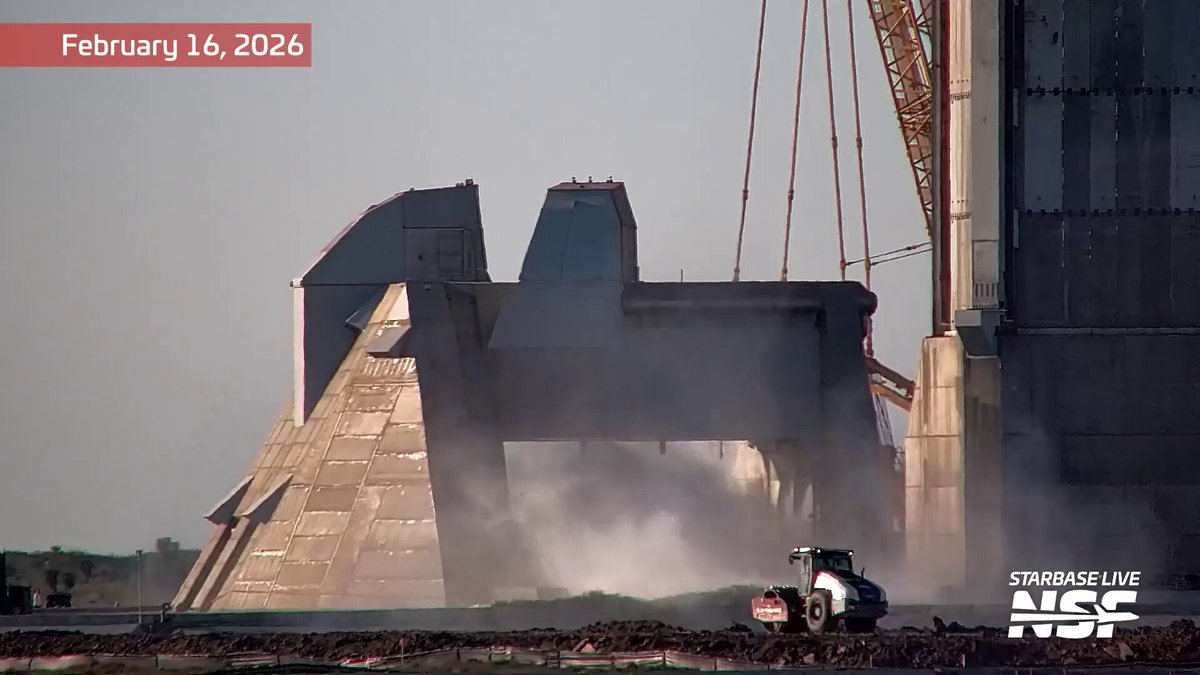
The News: SpaceX successfully completed a full water deluge system test at Starbase Orbital Launch Pad 2, validating the pad's readiness to host Super Heavy Booster 19 for its upcoming static fire sequence ahead of Starship Flight 12.
Why It Matters: This test clears a critical infrastructure checkpoint on the path to Flight 12 — expected as early as early March 2026 — which will debut the Block 3 (V3) Starship and Super Heavy configuration for the first time.
Source: @NASASpaceflight on X
SpaceX Completes Full Water Deluge Test at Starbase Pad 2 — Starship Flight 12 Closing In
Starbase Pad 2 just passed a major readiness gate. SpaceX conducted a full water deluge system test at its Orbital Launch Pad 2 in Boca Chica, Texas around February 16, 2026 — a dramatic, high-volume validation run that signals the pad is ready to support Super Heavy Booster 19's impending static fire, and ultimately, Starship Flight 12.

📊 Key Figures
| Metric | Detail | Context |
|---|---|---|
| Water Volume | ~350,000–422,000 gallons per operation | Needed to absorb acoustic energy and heat from 33 Raptor 3 engines |
| Engines Protected | 33 Raptor 3 engines (Super Heavy Booster 19) | Most powerful rocket booster ever built |
| Cryogenic Proof Tests | Multiple — completed Feb 2–4, 2026 | Booster 19 structural validation prior to engine installation |
| Deluge Test Date | ~February 16, 2026 | Full-duration pad validation run at Starbase Pad 2 |
| Flight 12 Target Window | Early March 2026 (potentially March 7) | Subject to static fire success and regulatory approval |
| Vehicles (Flight 12) | Booster 19 + Ship 39 | First flight of the Block 3 (V3) Starship configuration |
What Just Happened at Boca Chica
The water deluge system is not a minor support system — it is one of the most critical pieces of infrastructure on any orbital launch pad. When 33 Raptor 3 engines ignite simultaneously, they produce an almost incomprehensible amount of acoustic energy and thermal load. Without a functioning deluge system, that force would rapidly destroy the pad structure and potentially the vehicle itself.
SpaceX's system at Pad 2 is designed to release hundreds of thousands of gallons of water in the moments around ignition, suppressing both the shockwave and the flame trench heat. The test conducted around February 16 was a full-duration run — not a partial valve check or pressure test — confirming the entire system performs as designed under real operating conditions.
Pad 2 is SpaceX's second orbital launch mount at Starbase, and bringing it fully online significantly expands the company's capacity to increase Starship launch cadence. The original Pad 1 handled the first eleven Starship flights. Pad 2 entering operational readiness is a structural step-change for the program.
Booster 19: Where Things Stand
Super Heavy Booster 19 completed a series of cryogenic proof tests between February 2 and 4, 2026, validating its structural integrity under the extreme low-temperature conditions it will experience when loaded with liquid oxygen and liquid methane propellants. It is now being prepared with its 33 Raptor 3 engines ahead of its static fire at Pad 2.
The static fire — a full engine ignition with the booster held down on the mount — is the final major hardware validation before Booster 19 can be cleared for Flight 12. The deluge test completing successfully means that when that static fire happens, the pad infrastructure is confirmed ready to absorb it.
🔭 The BASENOR Take
Timeline
Early March 2026
Impact Level
🔴 High — Program Milestone
Confidence
High — Hardware Verified
The deluge test doesn't grab headlines the way a launch attempt does, but in terms of program pacing, it matters enormously. SpaceX cannot attempt Booster 19's static fire — let alone Flight 12 — without a validated pad. That box is now checked.
What's significant here is not just the test itself, but what it unlocks. Flight 12 is the debut of the Block 3 (V3) Starship configuration — the first time the new vehicle stack with Ship 39 and Booster 19 will attempt an orbital flight profile. Every milestone on this checklist that gets cleared on schedule reinforces the credibility of the early March window Elon Musk has pointed to.
The remaining open items before Flight 12 can launch: Booster 19's static fire at Pad 2, successful integration of Booster 19 with Ship 39, and FAA launch license approval. None of those are trivial — but pad readiness is no longer a variable.
📰 Deep Dive
Pad 2 coming online represents more than just a backup to Pad 1. SpaceX's stated ambition is to dramatically increase Starship launch frequency, and you cannot do that from a single pad that requires extended refurbishment time between flights. Having two fully operational orbital mounts at Starbase is a prerequisite for achieving anything approaching rapid reuse cadence.
The water deluge system at Pad 2 also incorporates lessons learned from the first eleven Starship flights, including refinements made after early flights caused significant pad damage. The fact that the system passed a full-duration validation test without incident is an indicator of SpaceX's ongoing iteration on ground support infrastructure — often less visible than rocket hardware changes, but equally important.
Flight 12's significance extends beyond pad utilization. As the first flight of the Block 3 configuration, it carries both Booster 19 and Ship 39 into the profile as upgraded vehicles. The program is no longer running early-prototype hardware — it is iterating on designs that are progressively closer to the operational Starship SpaceX intends to use for commercial payload delivery and, eventually, lunar and Mars missions.
For the Starship program overall, the rhythm of the past several weeks — cryogenic proof tests on Booster 19, followed by a clean deluge test at Pad 2 — reflects a program operating with increasing procedural discipline. Whether the March window holds will depend on factors including regulatory timelines that are outside SpaceX's direct control, but on the hardware side, the momentum is clearly building.
🚀 Following the Starship program? See every test flight, official outcome and the next launch window in our SpaceX Starship Tracker.
Sources & reporting notes
The links below identify the material source records used for this report.
- @NASASpaceflight on X (2026-02-19T01:34:51.000Z) — Direct source
Source links are preserved as published or accessed. See our editorial standards and corrections policy.
The BASENOR Editorial Desk covers Tesla, SpaceX, and related technology, curating reporting from primary sources — official accounts, regulatory filings, and software release data. Every article passes source-record and fact-checking review before publication. About the newsroom.
This report was curated by the BASENOR Editorial Desk from the sources listed above. Read our editorial standards or email editorial@basenor.com to report an error.