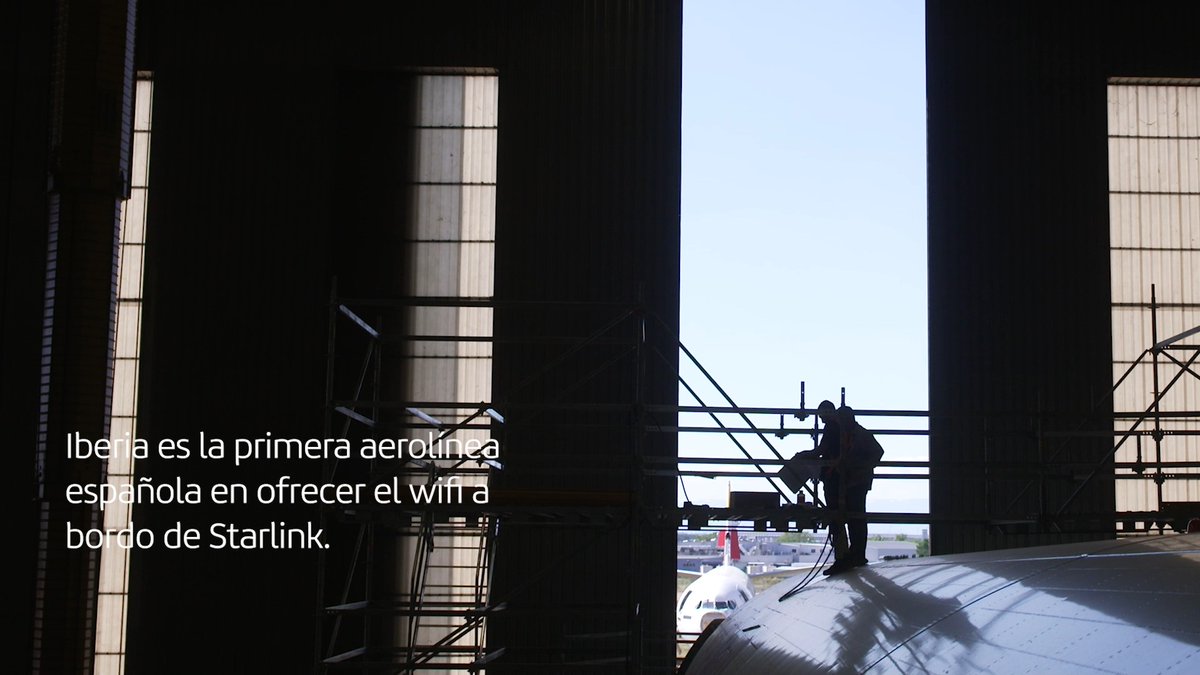
Starlink has officially taken to the skies with Iberia Airlines. The Spanish carrier completed its inaugural Starlink-equipped commercial flight on the evening of June 23, 2026 — a Madrid-to-São Paulo service — marking the start of a significant rollout across one of Europe's largest airline groups.

What Happened
Flight IB3267, operating on aircraft registration EC-MAA out of Adolfo Suárez Madrid-Barajas airport, became the first Iberia flight to carry passengers with live Starlink connectivity. The milestone signals that installations are no longer in the planning phase — hardware is going onto planes now.
According to Iberia's rollout plan, 35% of its long-haul fleet will be equipped with Starlink by the end of 2026. The broader ambition is larger still: Iberia's parent company, International Airlines Group (IAG), has committed to deploying Starlink across more than 500 aircraft spanning its entire portfolio of airlines.
What Passengers Actually Get
This isn't the throttled, pay-per-hour Wi-Fi that frequent flyers have learned to ignore. According to verified specifications, Iberia's Starlink connection is expected to deliver download speeds of up to 450–500 Mbps and upload speeds of up to 70 Mbps — figures that rival many home broadband connections. The service will be gate-to-gate, meaning connectivity from the moment you board to the moment you disembark.
Perhaps most notably: it will be free for all passengers across every cabin class — Economy, Premium Economy, and Business alike. No paywalls, no upsells.
The Bigger Picture
This rollout is part of Iberia's Flight Plan 2030, a €6 billion investment program centered on innovation and digitalization. The Starlink partnership is one of its most visible consumer-facing bets. For SpaceX, landing IAG as a customer — with 500+ aircraft across multiple carriers — represents a meaningful expansion of its aviation segment, which now counts airlines across multiple continents among its clients.
The aviation market has long been the hardest nut for in-flight connectivity providers to crack: high speeds at altitude, across oceans, with zero tolerance for outages. Starlink's low-earth-orbit architecture addresses the latency and coverage gaps that plagued older geostationary satellite systems. Iberia's first flight is early proof that the technology is ready for commercial scale.
With installations actively underway and a confirmed first flight in the books, the question now is how quickly the rest of IAG's fleet follows. If the rollout stays on schedule, Iberia passengers on long-haul routes could be streaming, video-calling, and working at 35,000 feet — for free — before the year is out.
Sources & reporting notes
The links below identify the material source records used for this report.
- @SawyerMerritt on X (2026-06-24T13:00:05.000Z) — Direct source
Source links are preserved as published or accessed. See our editorial standards and corrections policy.
The BASENOR Editorial Desk covers Tesla, SpaceX, and related technology, curating reporting from primary sources — official accounts, regulatory filings, and software release data. Every article passes source-record and fact-checking review before publication. About the newsroom.
This report was curated by the BASENOR Editorial Desk from the sources listed above. Read our editorial standards or email editorial@basenor.com to report an error.