30-Second Brief
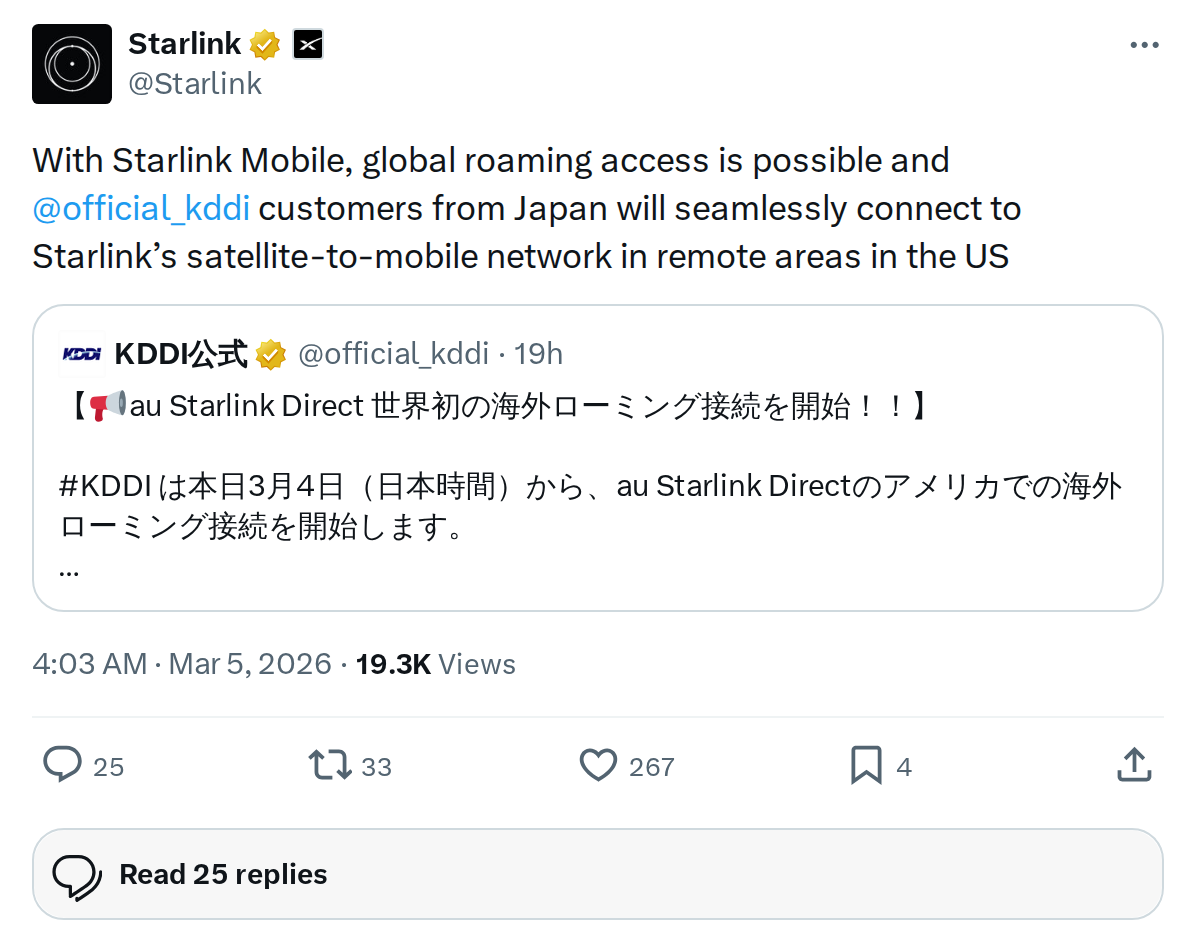
The News: Starlink has announced global roaming capability for Starlink Mobile, with KDDI customers in Japan among the first to gain seamless satellite-to-mobile connectivity in remote areas of the United States.
Why It Matters: This marks a significant step toward a truly borderless satellite network — one that could eventually extend to Tesla vehicles and other connected devices worldwide.
Source: @Starlink on X
Starlink Mobile Is Now a Global Roaming Network
Starlink just made a move that signals it is no longer just a home broadband provider or a niche off-grid solution — it is building the infrastructure for a truly global satellite-to-cellular network. The announcement that KDDI customers in Japan will be able to seamlessly connect to Starlink's satellite-to-mobile network in remote areas of the United States is a concrete, carrier-level proof point of that ambition.

The partnership between SpaceX and KDDI is not brand new — the two companies announced their agreement back in August 2023, with the goal of delivering satellite-to-cellular service using Starlink's low Earth orbit constellation and KDDI's national network infrastructure in Japan. What is new today is the activation of the global roaming piece: KDDI subscribers will not need a separate Starlink plan or device. Their existing mobile service will bridge onto the satellite network when terrestrial coverage disappears.
That is the key distinction. This is not a separate satellite phone product. It is your regular SIM, your regular phone, connecting to space when the cell towers run out. For anyone who has ever lost signal in a national park, on a mountain pass, or in a rural stretch of highway — this is what the future of mobile looks like.
📊 Key Figures
| Metric | Value | Context |
|---|---|---|
| Partnership Announced | August 30, 2023 | SpaceX + KDDI agreement signed |
| Coverage Region (Roaming) | United States | Remote areas, no terrestrial signal |
| Home Market | Japan | KDDI national subscriber base |
| Orbit Type | Low Earth Orbit (LEO) | Lower latency vs. geostationary |
🔭 The BASENOR Take
Timeline: KDDI-SpaceX agreement signed August 2023 → Global roaming activation announced March 2026
Impact Level: 🟠 High — First major carrier-to-carrier satellite roaming deployment in the Starlink ecosystem
Confidence: ✅ Confirmed — Announced directly by @Starlink official account
The reason this matters beyond the KDDI deal itself is what it proves about Starlink's architecture. For satellite-to-mobile to work as a roaming service — not just a standalone product — the network has to be carrier-grade in its handoff logic, billing integration, and regulatory compliance across borders. Getting a Japanese carrier to route its customers through US satellite coverage is a non-trivial technical and regulatory achievement.
For SpaceX, this is also a commercial model validation. Rather than selling directly to consumers, partnering with established carriers like KDDI allows Starlink to scale adoption without building a retail presence in every market. If this model replicates across Asia-Pacific, Europe, and Latin America — and SpaceX has signaled that is the intent — Starlink Mobile becomes the de facto global backup layer for every major carrier on Earth.
What This Means for the Tesla Ecosystem
Tesla owners already benefit from Starlink connectivity through the Starlink dish option for Cybertruck and through SpaceX's broader infrastructure investments. But the satellite-to-mobile story is increasingly relevant to the in-vehicle connectivity picture. Tesla vehicles rely on cellular data for navigation updates, over-the-air software updates, live traffic, Sentry Mode cloud backup, and the Tesla app connection. In dead zones, that connectivity disappears entirely.
A mature Starlink Mobile network — one where carriers worldwide route their customers through satellite coverage automatically — could eventually mean Tesla's onboard LTE modem never truly loses signal. That is not an announced Tesla feature, but it is the logical endpoint of the infrastructure being built right now. Our SpaceX coverage has tracked this trajectory for over two years.
The KDDI announcement is a small but meaningful step. It shows the roaming model works, it shows a Tier-1 carrier is willing to stake its customer experience on Starlink's reliability, and it sets a template that other carriers will follow. Watch for similar announcements from carriers in markets where Tesla has significant owner populations — particularly Europe and Australia.
📰 Deep Dive
The satellite-to-cellular space has seen a lot of announcements over the past three years — from Apple's Emergency SOS via satellite to T-Mobile's own Starlink partnership in the United States. What separates today's KDDI announcement is the international roaming dimension. Previous Starlink Mobile deals have largely been domestic: a carrier in one country offering satellite backup within that country's borders. Routing a Japanese carrier's customers through satellite coverage on US soil is a different beast entirely, requiring coordination across regulatory frameworks, spectrum licensing, and roaming agreements that traditionally take years to negotiate.
The fact that the SpaceX-KDDI partnership was signed in August 2023 and is only now reaching the global roaming activation stage gives you a sense of that complexity. It also suggests that SpaceX has been methodically working through the regulatory and technical checklist rather than rushing to market. That discipline, if it holds, bodes well for the reliability of the service when it does reach end users.
For the broader EV and connected vehicle industry, the implications are significant. As vehicles become more dependent on continuous connectivity — for autonomous driving data, fleet management, remote diagnostics, and software updates — the ability to maintain that connection in rural and remote areas becomes a safety and functionality issue, not just a convenience one. Starlink Mobile's global roaming ambition is, in that sense, infrastructure that the entire connected vehicle ecosystem will eventually depend on.
Sources & reporting notes
The links below identify the material source records used for this report.
- @Starlink on X (2026-03-04T20:03:14.000Z) — Direct source
Source links are preserved as published or accessed. See our editorial standards and corrections policy.
The BASENOR Editorial Desk covers Tesla, SpaceX, and related technology, curating reporting from primary sources — official accounts, regulatory filings, and software release data. Every article passes source-record and fact-checking review before publication. About the newsroom.
This report was curated by the BASENOR Editorial Desk from the sources listed above. Read our editorial standards or email editorial@basenor.com to report an error.