30-Second Brief
The News: Starlink officially announced a partnership with Southwest Airlines to provide high-speed, low-latency internet to passengers starting summer 2026, with over 300 aircraft equipped by year-end.
Why It Matters: This marks Starlink's largest commercial aviation deployment to date and signals SpaceX's aggressive push into the in-flight connectivity market—the same satellite network that powers connectivity for Tesla owners in remote areas.
Source: @Starlink on X
📊 Key Figures
| Metric | Figure | Context |
|---|---|---|
| Aircraft Deployment | 300+ | Southwest planes equipped by end of 2026 |
| Launch Timeline | Summer 2026 | First Starlink-equipped flights go live |
| Download Speeds | 135-310 Mbps | Per terminal performance (Starlink Aviation spec) |
| Upload Speeds | 20-44 Mbps | Enables video calls and large file uploads |
| Latency | <99ms | Low enough for gaming and real-time apps |
| Satellite Network | 9,000+ | Low-Earth-orbit satellites in Starlink constellation |
The Official Announcement
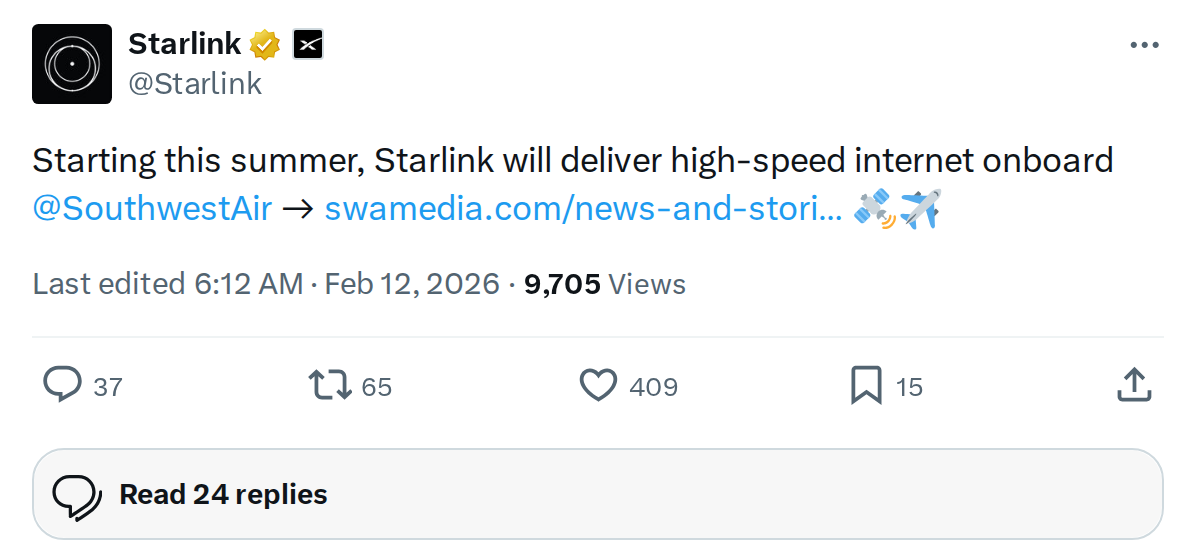
Starlink made the announcement on X just hours ago, confirming what industry watchers have been anticipating since the company began expanding its aviation division:

The announcement is brief but significant: Southwest Airlines will begin deploying Starlink's satellite internet across its entire domestic network starting this summer. According to Southwest's investor relations announcement, the first aircraft will enter service in summer 2026, with more than 300 planes equipped by the end of the year.
This represents the largest commercial aviation deployment for Starlink to date and positions SpaceX's satellite division as a major disruptor in the in-flight connectivity market—a sector traditionally dominated by legacy providers like Gogo and ViaSat.
🔭 The BASENOR Take
Timeline: Aggressive. First flights go live in 4-5 months, with full fleet coverage by December 2026.
Impact Level: High for aviation, Medium-High for Tesla ecosystem.
Confidence: 95% — Southwest has publicly committed, and Starlink Aviation is already operational on other carriers.
What This Means for Tesla Owners
If you own a Tesla, you're already familiar with SpaceX's execution speed and integration philosophy. The same low-Earth-orbit satellite network that enables Starlink internet service—including potential future Tesla connectivity features—is now powering commercial aviation.
Here's why this matters:
- Ecosystem Synergy: Starlink's expansion into aviation validates the low-latency satellite model that could eventually support over-the-air updates for Teslas in areas with poor cellular coverage.
- Network Effect: Every Southwest plane adds load-balancing capacity to the Starlink constellation, improving overall network performance—including for ground-based users.
- SpaceX Revenue: Aviation contracts generate significant recurring revenue for SpaceX, funding continued Starship development and satellite launches—both critical to Elon's long-term vision.
The Competitive Landscape
Starlink Aviation already serves other carriers, but Southwest represents a massive scale-up. According to Southwest's announcement, the airline will continue offering free WiFi to Rapid Rewards members on Starlink-equipped flights—a significant competitive differentiator in an industry where most airlines charge for premium connectivity.
The technical specs are impressive: 135-310 Mbps download speeds and sub-99ms latency enable HD streaming, live gaming, and video conferencing at 35,000 feet. That's comparable to home broadband speeds and a dramatic improvement over traditional in-flight WiFi, which typically struggles with basic web browsing.
📰 Deep Dive: Why Aviation Matters to the Tesla Story
At first glance, an airline WiFi partnership might seem tangential to Tesla news. But the connection runs deeper than most realize.
Starlink operates a constellation of over 9,000 low-Earth-orbit satellites—a network that SpaceX has been methodically building since 2019. Every commercial contract, from residential internet to maritime to aviation, generates revenue that funds SpaceX's core mission: making life multiplanetary. That same mission drives Elon's vision for Tesla, which he's repeatedly framed as accelerating sustainable energy to give humanity the resources needed for space exploration.
The Southwest partnership is particularly strategic. With over 300 aircraft planned for deployment by year-end, this represents one of the largest single customer commitments in Starlink Aviation's history. It's also a validation of the technology's readiness for mass-market deployment—the kind of scale-up that SpaceX has mastered with Falcon 9 and is now applying to satellite internet.
For Tesla owners who follow the broader Elon Musk ecosystem, this announcement signals continued momentum across SpaceX's revenue-generating divisions. More Starlink revenue means more funding for Starship development, more satellite launches, and a stronger position in the emerging space economy. It's the same execution playbook that turned Tesla from a niche EV maker into the world's most valuable automaker.
The technical capabilities also hint at what's possible for future Tesla features. While Tesla currently relies on cellular connectivity for over-the-air updates and Premium Connectivity features, a satellite backup—using the same Starlink network—could theoretically provide coverage in remote areas where cellular service is unavailable. Elon has previously mentioned exploring Starlink integration for Tesla, though no official timeline exists.
What's clear is that SpaceX is executing on multiple fronts simultaneously—residential internet, maritime, aviation, and enterprise—while continuing to launch Starship prototypes and prepare for crewed missions. The Southwest deal is one more proof point that the Starlink business model works at scale, and that SpaceX is moving faster than traditional aerospace competitors.
🚀 Following the Starship program? See every test flight, official outcome and the next launch window in our SpaceX Starship Tracker.
Sources & reporting notes
The links below identify the material source records used for this report.
- @Starlink on X (2026-02-11T22:12:20.000Z) — Direct source
Source links are preserved as published or accessed. See our editorial standards and corrections policy.
The BASENOR Editorial Desk covers Tesla, SpaceX, and related technology, curating reporting from primary sources — official accounts, regulatory filings, and software release data. Every article passes source-record and fact-checking review before publication. About the newsroom.
This report was curated by the BASENOR Editorial Desk from the sources listed above. Read our editorial standards or email editorial@basenor.com to report an error.