📌 UPDATE — June 10, 2026
New deployment efficiency figures put the V3 capacity story in sharper relief: a single Starship launch will carry 60 V3 satellites, adding 61,000 Gbps of network capacity in one go. For comparison, a Falcon 9 carrying 27 Starlink V2 satellites adds just 2,600 Gbps — meaning one Starship launch equals the capacity of 23 Falcon 9 launches. This underscores that the V3 upgrade isn't just about per-satellite performance; the Starship–V3 pairing creates a compounding efficiency multiplier that could dramatically accelerate global coverage buildout.

via @SawyerMerritt · June 10, 2026
📌 UPDATE — June 4, 2026
Elon Musk has clarified that the total bandwidth gain from Starlink V3 is actually 100x over V2 — not just 10x. The multiplier comes from two compounding factors: each V3 satellite carries 10x the bandwidth of a V2 unit, and SpaceX plans to launch more than 10x as many of them, putting the aggregate network capacity leap at over 100x. Additionally, Musk revealed that V3 satellites will operate at a significantly lower orbital altitude of 350km instead of 550km, cutting the physics-limited round-trip latency roughly in half. With light traveling 300km per millisecond in space, that altitude drop brings minimum latency below 5ms — a figure that would rival or beat most wired broadband connections for raw ping.

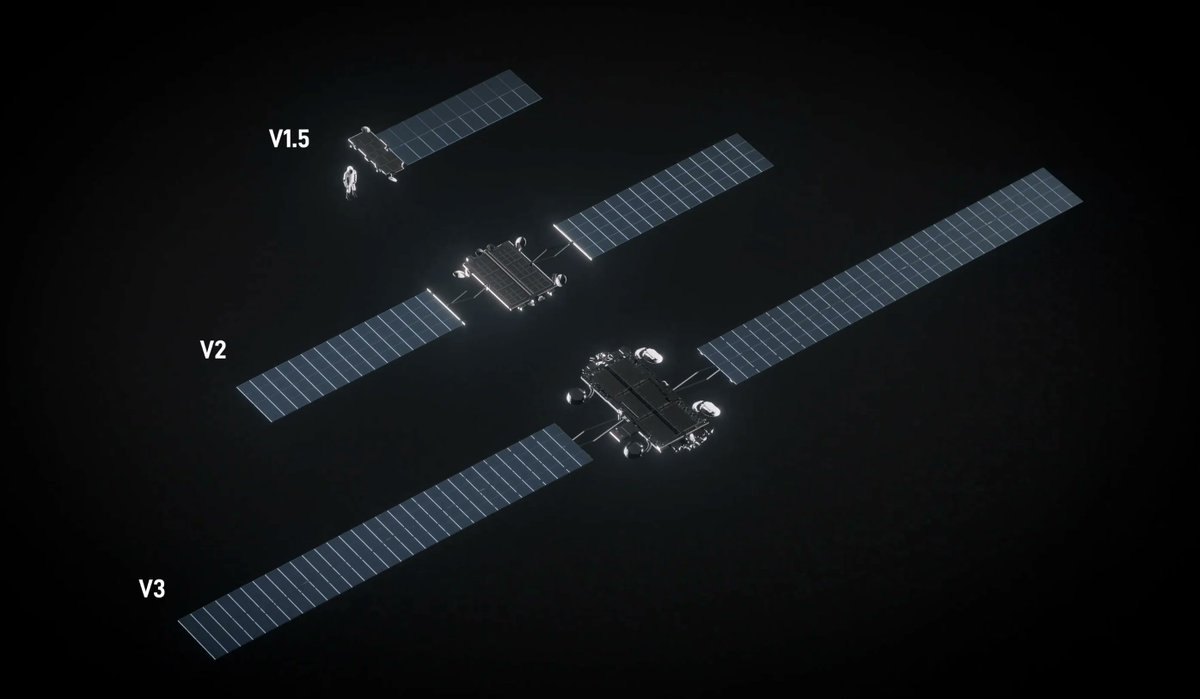
SpaceX has revealed the headline specifications for its third-generation Starlink satellites, and the numbers represent a step-change rather than an incremental upgrade. Set to begin deployment in late 2026, Starlink V3 pushes per-satellite bandwidth from 96 Gbps to 1,024 Gbps — a 10x-plus leap — while Starship's higher payload capacity compounds that gain into a launch-efficiency story that no competitor can currently match.

The Numbers in Context
| Metric | V2 (Falcon 9) | V3 (Starship) | Multiplier |
|---|---|---|---|
| Bandwidth per satellite | 96 Gbps | 1,024 Gbps | ~10.7× |
| Satellites per launch | 27 | 60 | ~2.2× |
| Bandwidth per launch | 2,600 Gbps | 61,000 Gbps | ~23.5× |
That last figure is the one worth sitting with. A single Starship mission carrying 60 V3 satellites adds roughly 23 times more capacity to the network than a Falcon 9 mission carrying 27 V2 satellites. The per-satellite improvement is dramatic on its own, but Starship's payload advantage multiplies it further — which is precisely why SpaceX spent years qualifying Starship for satellite deployment before committing to V3.
Why the Bandwidth Jump Is So Large
The V2 generation was already a substantial upgrade over the original Starlink design, introducing inter-satellite laser links that allowed the network to route traffic without relying solely on ground stations. V3 is expected to build on that architecture while incorporating a significantly larger antenna aperture and more advanced signal processing — allowing each satellite to serve far more simultaneous users at higher throughput. SpaceX has not published a full technical breakdown, but the 1,024 Gbps figure aligns with what engineers have described as the practical ceiling achievable within Starship's payload envelope.
The shift from Falcon 9 to Starship as the delivery vehicle is not incidental — it is structural to the V3 program. V3 satellites are physically larger and heavier than V2, making them incompatible with Falcon 9's fairing. Starship's cavernous payload bay and dramatically higher lift capacity are what make the 60-satellite-per-launch cadence possible in the first place.
What Late 2026 Deployment Actually Means
SpaceX has indicated V3 deployment begins in late 2026, but the network effect will take time to materialize. A constellation upgrade of this magnitude requires dozens of launches before V3 satellites represent a meaningful share of total capacity. Early beneficiaries are likely to be high-demand regions where the existing V2 network is most congested — dense urban markets and maritime corridors — rather than the rural and remote users who were Starlink's original audience.
For existing Starlink subscribers, the practical implication is that speeds and reliability should improve progressively as V3 satellites enter service and older V1 hardware is deorbited. The timeline for that improvement reaching any given user depends heavily on how quickly SpaceX can ramp Starship launch cadence — which remains the key variable the company has not yet fully locked down.
The competitive picture is equally significant. No other operator currently has a rocket capable of deploying satellites at V3's scale per mission. That structural advantage gives SpaceX a capacity-building rate that rivals will struggle to match, regardless of their own satellite designs. Whether that translates into lower prices for end users or simply faster network buildout is a question SpaceX's commercial strategy will answer over the next 18 to 24 months. For our SpaceX coverage, the V3 announcement is the clearest signal yet that Starship's commercial role is no longer theoretical.
🚀 Following the Starship program? See every test flight, official outcome and the next launch window in our SpaceX Starship Tracker.
Sources & reporting notes
The links below identify the material source records used for this report.
- @SawyerMerritt on X (2026-06-04T13:39:23.000Z) — Direct source
- @elonmusk on X (2026-06-04T22:26:04.000Z) — Direct source
- @SawyerMerritt on X (2026-06-10T04:37:54.000Z) — Direct source
Source links are preserved as published or accessed. See our editorial standards and corrections policy.
The BASENOR Editorial Desk covers Tesla, SpaceX, and related technology, curating reporting from primary sources — official accounts, regulatory filings, and software release data. Every article passes source-record and fact-checking review before publication. About the newsroom.
This report was curated by the BASENOR Editorial Desk from the sources listed above. Read our editorial standards or email editorial@basenor.com to report an error.