30-Second Brief
The News: SpaceX has lifted Super Heavy Booster 19 onto Orbital Launch Pad 2 at Starbase in preparation for Starship Flight 12, with observers noting approximately nine Raptor 3 engines currently installed — well short of the full 33-engine complement.
Why It Matters: The partial engine configuration signals a deliberate, phased testing approach, likely meaning a static fire with reduced engines before the full load-out is complete — a methodical cadence that could push the Flight 12 launch toward the April window Elon Musk confirmed last week.
Sources: @NASASpaceflight · @CSI_Starbase
Starship Flight 12: Super Heavy Booster 19 Rolls Onto Pad 2 With Partial Engine Load — What It Means
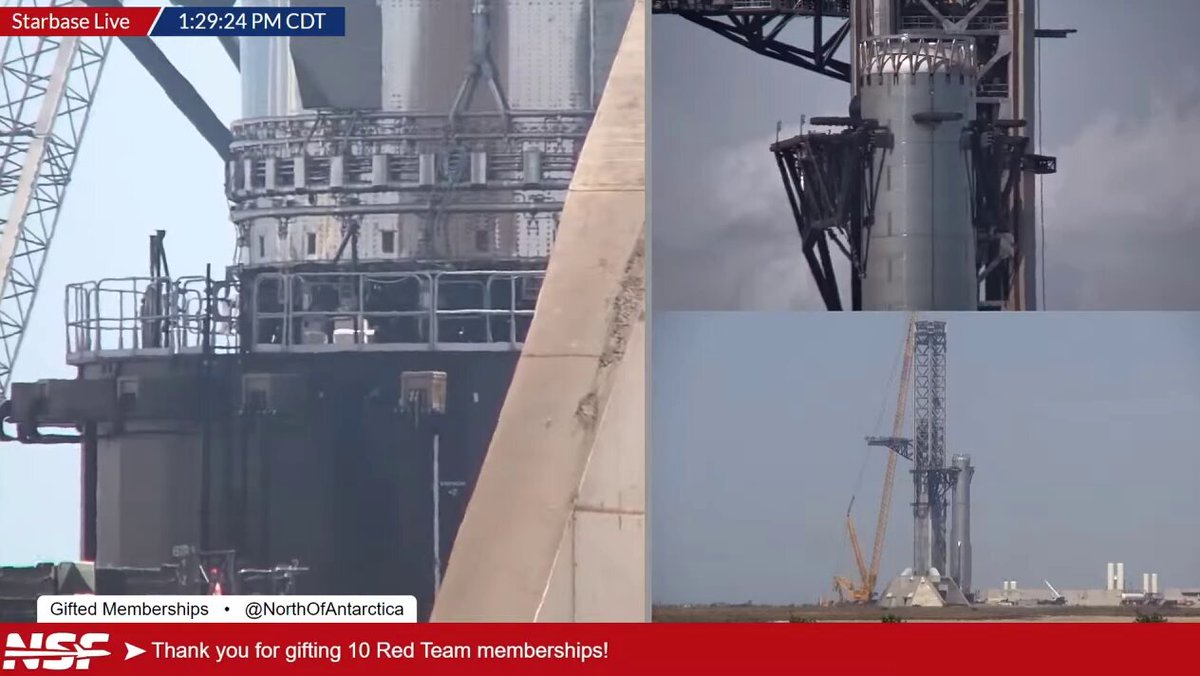
SpaceX is moving fast on Starship Flight 12. On Sunday afternoon, cameras at Starbase captured Super Heavy Booster 19 being lifted onto Orbital Launch Pad 2 — the upgraded launch mount that has been undergoing infrastructure testing for weeks. What caught the attention of the Starship-watching community immediately: the booster is carrying only around nine Raptor 3 engines, not the full 33 it will eventually fly with.

📊 Key Figures
| Metric | Value | Context |
|---|---|---|
| Engines currently installed | ~9 | Full load = 33 |
| Engine type | Raptor 3 | 19–22% more thrust vs Raptor 2 |
| Booster height (Block 3) | 72.3 m | +1.3 m vs Block 2 |
| Grid fins (Block 3) | 3 | Down from 4 on Block 2 |
| Engine installation start | ~Feb 15, 2026 | After cryo tests Feb 4–7 |
| Elon's stated launch window | ~4 weeks out | Confirmed March 7 → ~Apr 9 |
| FCC license window | Apr 5 – Oct 5, 2026 | Communications license granted |
A Booster Unlike Any We've Seen Before
NASASpaceflight's team described the scene at Starbase as "a unique sight" — and that's not hyperbole. Super Heavy Booster 19 is the first Block 3 (Version 3) Super Heavy, standing 72.3 meters tall with three grid fins instead of four. It's designed to fly 33 Raptor 3 engines, each delivering 19–22% more thrust than the Raptor 2 units used on previous flights.

But right now, only around nine of those 33 engine slots are filled. That's deliberate — and it's actually a sign of maturity in SpaceX's test program.
Why the Partial Engine Load Is Significant
Starbase observer Zack Golden (@CSI_Starbase) put it plainly: a partial engine load means a slower, more methodical testing process — and that's a good thing.

The working theory: SpaceX will conduct a static fire test at Pad 2 with the partial engine set — validating the new Raptor 3 units and the upgraded Pad 2 infrastructure simultaneously — before completing the full 33-engine installation. A static fire attempt was expected as early as March 8–10, 2026, with a road closure already scheduled for March 8.
This approach also makes sense given that Raptor 3 is a new engine generation. You don't light 33 brand-new engines for the first time simultaneously if you can help it. Start with nine, verify behavior, then scale up.

🔭 The BASENOR Take
Flight 12 isn't just another Starship test — it's the debut of an entirely new vehicle generation. The Block 3 Super Heavy and Starship 39 represent meaningful hardware upgrades: a taller booster, fewer but larger grid fins, and a completely new engine generation in Raptor 3. SpaceX is treating this accordingly.
The phased engine installation strategy is the most telling signal here. Pad 2 itself is also new to flight operations — its water-cooled top deck and deluge system were only tested in February. Running a partial static fire lets SpaceX validate both the pad and the engines in a lower-stakes configuration before committing to a full 33-engine ignition.
With Elon Musk confirming a roughly four-week timeline on March 7 and the FCC license window opening April 5, the math points to a launch attempt in the first half of April. The next critical milestone to watch: the static fire at Pad 2. If that goes cleanly, remaining engine installation and stacking of Starship 39 on top of B19 should follow in quick succession. For Tesla owners who track SpaceX as a bellwether for Elon's engineering culture, this is the program moving with purpose. For our full SpaceX coverage, check the dedicated tag.
📰 Deep Dive
What makes today's pad rollout especially noteworthy is the convergence of firsts. Pad 2 at Starbase has never hosted a live flight — all previous Starship launches used Pad 1. The infrastructure upgrades at Pad 2, including the new orbital launch mount with its water-cooled deck, were designed with lessons learned from the first eleven flights baked in. Seeing Booster 19 stand on that mount for the first time is the culmination of months of parallel construction and testing work.
The Raptor 3 engine itself is a significant step forward. The 19–22% thrust increase over Raptor 2 isn't just a performance number — it changes the margin calculations for the entire vehicle. More thrust per engine means SpaceX can potentially achieve similar or better performance even if one or two engines experience anomalies mid-flight, which has historically been one of the program's key risk factors. Testing these engines in a partial configuration first is prudent engineering, not a sign of trouble.
The Block 3 structural changes are also worth noting. Reducing grid fins from four to three is a counterintuitive move — fewer control surfaces sounds like less control authority — but SpaceX's aerodynamic simulations and flight data from previous missions apparently support the change, likely reducing mass and drag simultaneously. The 1.3-meter height increase on the booster suggests additional propellant capacity or structural reinforcement, details that haven't been fully disclosed yet.
For the broader Starship program, a successful Flight 12 would be a major stepping stone toward the operational cadence NASA's Artemis program requires for the Human Landing System. Every successful test flight tightens the timeline on that commitment — and every piece of hardware now sitting on Pad 2 is a concrete step in that direction.
🚀 Following the Starship program? See every test flight, official outcome and the next launch window in our SpaceX Starship Tracker.
Sources & reporting notes
The links below identify the material source records used for this report.
- @NASASpaceflight on X (2026-03-08T18:30:10.000Z) — Direct source
- @NASASpaceflight on X (2026-03-08T18:33:34.000Z) — Direct source
- @CSI_Starbase on X (2026-03-08T18:41:59.000Z) — Direct source
- @NASASpaceflight on X (2026-03-08T18:47:28.000Z) — Direct source
Source links are preserved as published or accessed. See our editorial standards and corrections policy.
The BASENOR Editorial Desk covers Tesla, SpaceX, and related technology, curating reporting from primary sources — official accounts, regulatory filings, and software release data. Every article passes source-record and fact-checking review before publication. About the newsroom.
This report was curated by the BASENOR Editorial Desk from the sources listed above. Read our editorial standards or email editorial@basenor.com to report an error.