
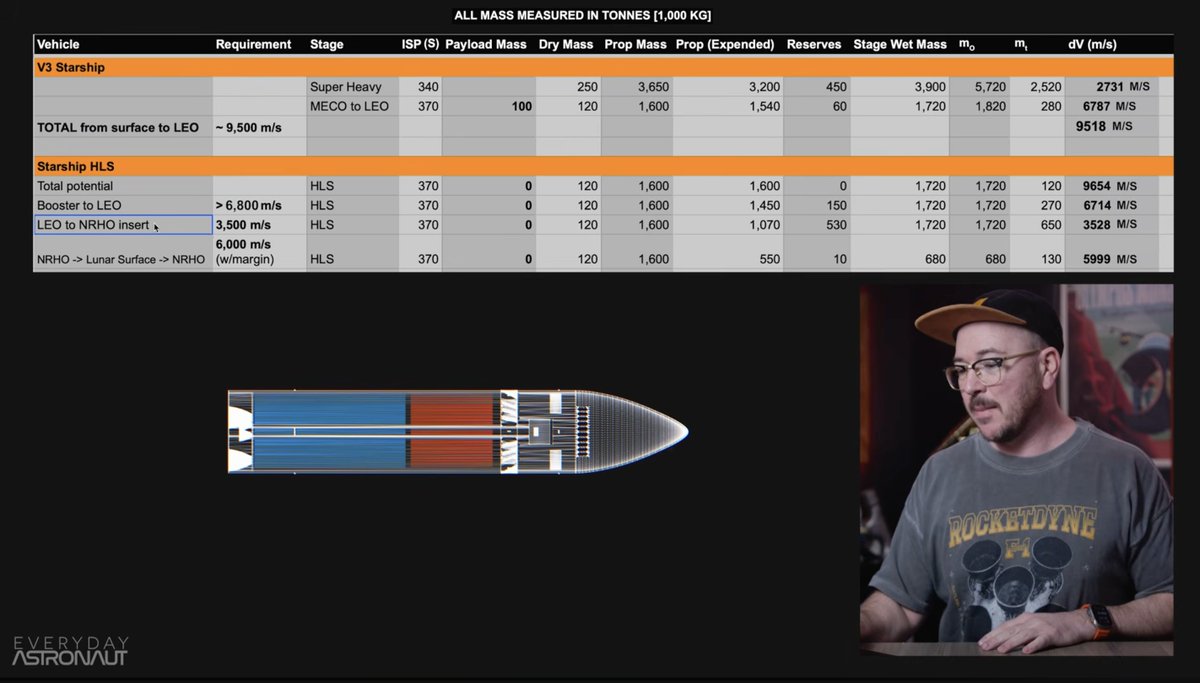
A quick back-of-the-envelope calculation from space communicator Tim Dodd — better known as Everyday Astronaut — is putting a concrete number on one of the most logistically complex parts of SpaceX's deep-space ambitions: orbital refueling. Swap the commonly cited 100-tonne payload figure for a more conservative 65-tonne estimate for Starship V3, and the math spits out roughly 22 refueling trips per mission. That's not a shocking number, Dodd notes — but it's a useful one for understanding what the road to the Moon and Mars actually looks like from a launch-cadence perspective.

1. The 65-Tonne Figure Is Conservative by Design
SpaceX officially targets over 100 metric tons to Low Earth Orbit for Starship V3 in a fully reusable configuration. Dodd's 65-tonne estimate isn't a prediction of failure — it's a deliberate stress-test of the math. Real-world payload margins on new vehicle generations routinely come in below design targets during early operational years, so 65 tonnes represents a reasonable floor for planning purposes rather than a ceiling for ambition.
2. The 22-Trip Figure Comes From an Established Model
Dodd didn't generate this number fresh — he applied a payload sensitivity check to analysis he had already published in a dedicated orbital refueling explainer video. Replacing 100 tonnes with 65 tonnes in that same model produced 22 refueling flights. The methodology has been publicly available for scrutiny, which gives the output more credibility than a standalone estimate. It also means the number scales predictably: close the gap between 65 and 100 tonnes and the trip count drops accordingly.
3. What "22 Refueling Trips" Actually Requires
Each refueling trip means a separate Starship tanker launch, a rendezvous in low Earth orbit, a propellant transfer, and a safe de-orbit of the tanker. At 22 trips, you're looking at a sustained launch cadence that demands near-simultaneous pad availability, reliable on-orbit docking, and cryogenic propellant management in the vacuum of space — none of which are trivial. SpaceX has been developing orbital propellant transfer technology as a core program requirement, partly driven by NASA's Human Landing System contract for Artemis.
4. The Number Isn't Surprising — and That's the Point
Dodd's own framing is telling: "that's not that surprising." The implication is that analysts and engineers working through the orbital refueling problem have been arriving at figures in this range for some time. A mission architecture requiring 20-plus tanker flights is demanding, but it's within the operational envelope SpaceX has been designing toward with Starbase's multi-pad infrastructure and rapid reusability goals. The number validates the scale of the challenge without invalidating the approach.
5. Payload Capacity Is the Single Biggest Variable
The sensitivity of the refueling trip count to payload capacity is steep. Moving from 100 tonnes to 65 tonnes — a 35% reduction — pushes the trip count up significantly. This means every kilogram of payload improvement SpaceX engineers into V3 directly reduces mission complexity and cost. It also means the gap between V3's paper specs and its demonstrated performance will be one of the most closely watched metrics once the vehicle begins operational flights. For missions beyond the Moon — Mars, in particular — shaving even a handful of refueling trips off the manifest could be the difference between a feasible launch window and a missed one.
🚀 Following the Starship program? See every test flight, official outcome and the next launch window in our SpaceX Starship Tracker.
Sources & reporting notes
The links below identify the material source records used for this report.
- @Erdayastronaut on X (2026-10-23T00:46:16.000Z) — Direct source
Source links are preserved as published or accessed. See our editorial standards and corrections policy.
The BASENOR Editorial Desk covers Tesla, SpaceX, and related technology, curating reporting from primary sources — official accounts, regulatory filings, and software release data. Every article passes source-record and fact-checking review before publication. About the newsroom.
This report was curated by the BASENOR Editorial Desk from the sources listed above. Read our editorial standards or email editorial@basenor.com to report an error.