Tesla is building out a new rider-facing feature for its Cybercab autonomous taxi service: the ability to pull up live rear and repeater camera feeds on demand from the vehicle's touchscreen. The development was confirmed by Tesla community insider Sawyer Merritt on October 10, 2026, who noted it directly addressed feedback he submitted after the Cybercab launch event — a signal that Tesla is actively iterating on the rider experience in real time.

What the Feature Does
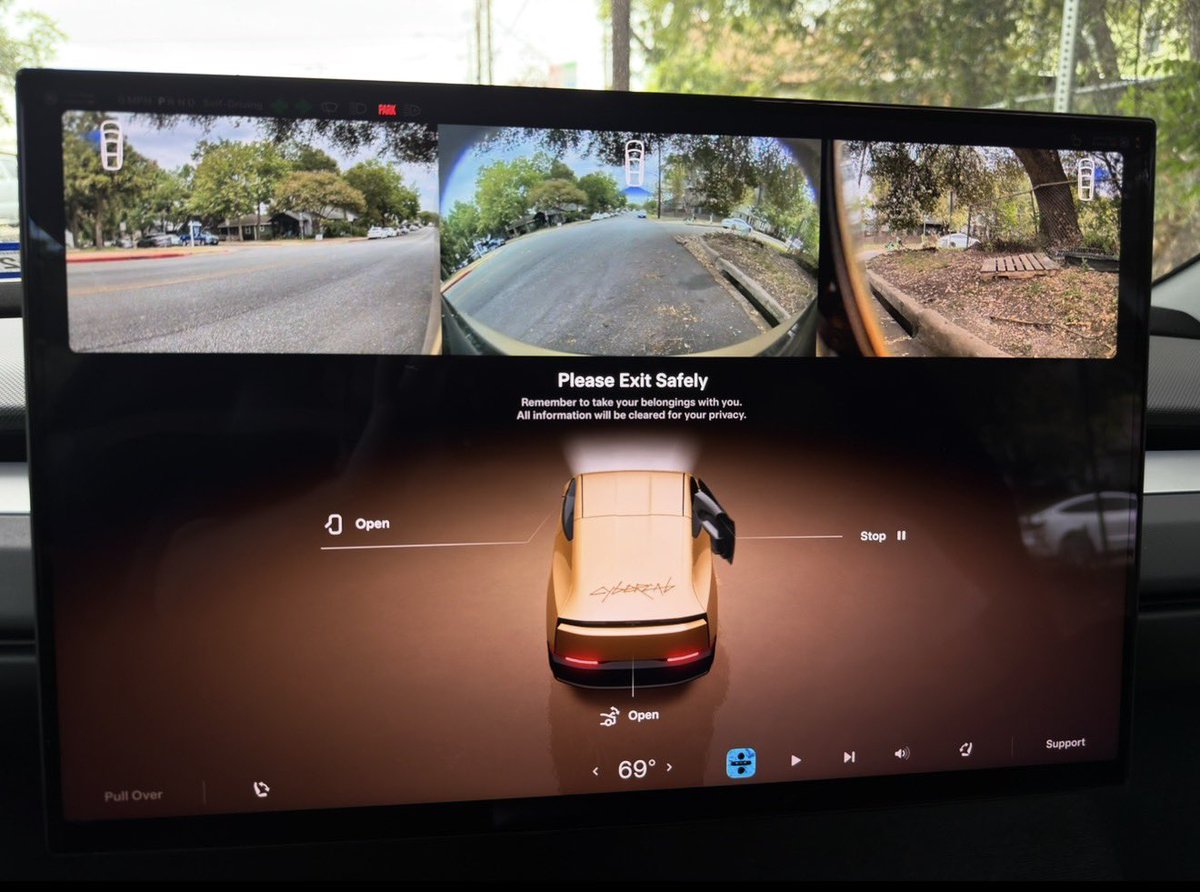
The planned feature will let Cybercab passengers tap into the vehicle's external camera array — specifically the rear camera and side repeater cameras — while riding. For a fully autonomous vehicle with no driver, this kind of situational awareness tool serves a different purpose than it would in a traditional car: it gives riders a window into what the car is seeing, which can help ease the anxiety of sitting in a vehicle with no human at the wheel.
The Cybercab is built around a camera-only autonomous driving architecture, with multiple external cameras covering the front, sides, and rear of the vehicle, plus integrated washer systems to keep lenses clean. That same camera array, according to verified reports, is also used for the vehicle's internal navigation display and safety status readouts on its large central touchscreen.

Not the First Time Riders Have Seen This Interface
The announcement has context worth understanding. Back in September 2026, at least two Cybercab riders — Matthew Skrzypczak and David Moss — independently documented an unexpected interface on the vehicle's touchscreen that included a virtual joystick and a live surround-camera feed. According to reports at the time, the feed showed external views including what appeared to be Supercharger stalls visible through the rear camera, suggesting full external camera access was already present in some form on the hardware.
That earlier interface was widely interpreted as an internal diagnostic or emergency tool — Tesla's first responder documentation references a joystick-based manual movement mode for service and emergency scenarios — that had been inadvertently exposed to riders. Tesla did not publicly acknowledge it as a consumer feature at the time.
What's new now is that Tesla appears to be formalizing and intentionally surfacing camera access as a rider-facing feature, rather than an accidental diagnostic leak. The distinction matters: it suggests Tesla is treating rider comfort and transparency as a product priority, not just an engineering afterthought.
Feedback Loop in Action
Merritt's post is notable for what it reveals about Tesla's development process for the Cybercab service. He explicitly stated this was one of his feedback items after the launch event, and credited Tesla for listening. For a service that launched with significant public scrutiny around safety, trust, and the passenger experience of riding in a driverless vehicle, the speed of this response is meaningful.
It also fits a broader pattern: Tesla has historically used real-world fleet data and community feedback to prioritize OTA updates and feature additions. Applying that same loop to a commercial robotaxi service — where the "users" are paying passengers rather than vehicle owners — represents a natural extension of that approach, and one that will likely define how the Cybercab product matures over the coming months.
No timeline for the feature's rollout has been confirmed. Given that the underlying camera hardware is already present and the interface has appeared on at least some vehicles in diagnostic form, the engineering lift may be relatively modest — but Tesla has not indicated when riders should expect to see it live.
🚕 Following the Robotaxi rollout? See every operating city, launch date and announced market in our Tesla Robotaxi Tracker.
Related Gear
Gear up your Tesla with tested, custom-fit BASENOR accessories — shop Tesla accessories →
Sources & reporting notes
The links below identify the material source records used for this report.
- @SawyerMerritt on X (2026-10-10T20:33:58.000Z) — Direct source
- @TeslaNewswire on X (2026-10-10T20:44:42.000Z) — Direct source
Source links are preserved as published or accessed. See our editorial standards and corrections policy.
The BASENOR Editorial Desk covers Tesla, SpaceX, and related technology, curating reporting from primary sources — official accounts, regulatory filings, and software release data. Every article passes source-record and fact-checking review before publication. About the newsroom.
This report was curated by the BASENOR Editorial Desk from the sources listed above. Read our editorial standards or email editorial@basenor.com to report an error.