📌 UPDATE — June 3, 2026
Tesla has now officially confirmed that the undocumented Driver Monitoring changes were present in update 2026.14.6.6 — not the subsequent release. The follow-up update 2026.14.6.7 contains only minor refinements and carries no FSD version bump, meaning owners who already received 2026.14.6.6 have had the new monitoring behavior active since that build. This confirmation closes the loop on which update introduced the changes, though the lack of original release notes remains unaddressed. 🔍

Source: @teslascope via X
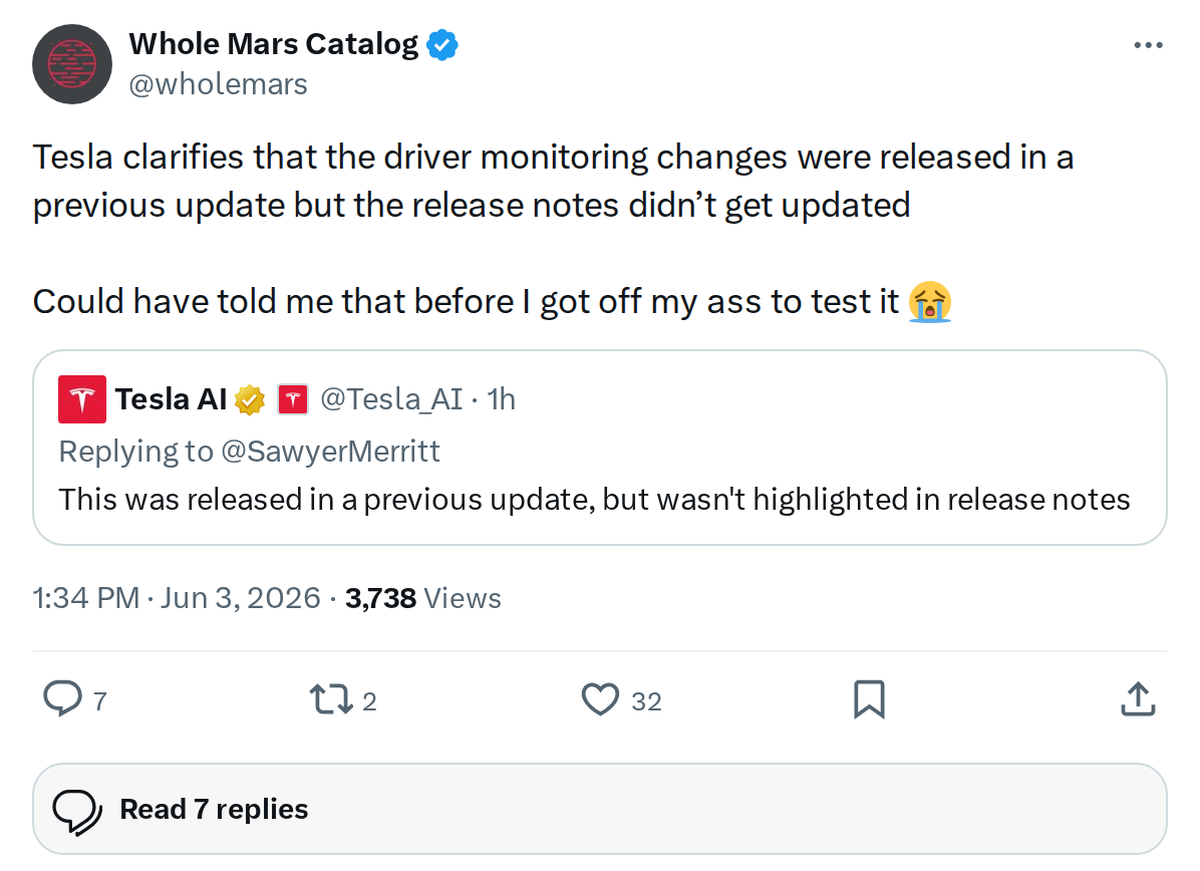
Tesla has quietly acknowledged that changes to its driver monitoring system were rolled out in an earlier software update — without any mention in the official release notes. The admission came after Tesla enthusiast and prominent owner-reporter Whole Mars Catalog went out of his way to physically test the feature, only to be told after the fact that it had already been live for some time.

The frustration is understandable. When Tesla ships a change to how it watches you drive — and doesn't document it — owners and testers have no way of knowing whether behavior they're observing is new, old, or a bug. That's exactly the situation that played out here.
According to verified sources, the feature in question is tied to Tesla's Vision-Based Attention Monitoring system, which uses the in-cabin camera to track eye gaze, head position, and steering inputs in real time. The cabin camera has been used for driver inattentiveness detection since the 2021.15.11 update, but its capabilities have expanded significantly since then — often without fanfare. A notable example: software version 2026.8.6, released around April 11, 2026, quietly added facial analysis for age estimation, a capability widely seen as groundwork for future Robotaxi operations. That change also never appeared in official release notes.
The most recent officially documented upgrade to the system arrived with FSD v14.3.3 (firmware 2026.14.6.7), which began rolling out to early access owners in the US and Canada on June 3. That update includes an officially labeled Enhanced Driver Monitoring System — improving eye gaze tracking sensitivity, better handling of glasses and sunglasses, and improved accuracy in low-light conditions. The goal is fewer unnecessary steering wheel nag prompts during FSD sessions. For that version, at least, Tesla put it in writing.
The broader pattern is worth noting: Tesla has a documented habit of shipping monitoring-related changes silently, then acknowledging them only when someone notices. For owners who rely on FSD (Supervised), the stakes aren't trivial — persistent inattention flags can trigger a Strikeout, suspending FSD access for roughly a week. Knowing exactly how and when the monitoring rules changed matters. Tesla's own privacy policy states that cabin camera images stay on the vehicle by default and are not used for facial recognition or identity linking, but the scope of what the camera analyzes continues to grow, documented or not.
The takeaway for owners: if your FSD monitoring behavior has felt different lately, it may not be your imagination — and there may not be a changelog entry to explain it.
📋 Tracking Tesla software? See every firmware, FSD and app version in one place in our Tesla Software Update Tracker.
Related Gear
Gear up your Tesla with tested, custom-fit BASENOR accessories — shop Tesla accessories →
Sources & reporting notes
The links below identify the material source records used for this report.
- @wholemars on X (2026-06-03T05:34:42.000Z) — Direct source
- @teslascope on X (2026-06-03T07:20:59.000Z) — Direct source
Source links are preserved as published or accessed. See our editorial standards and corrections policy.
The BASENOR Editorial Desk covers Tesla, SpaceX, and related technology, curating reporting from primary sources — official accounts, regulatory filings, and software release data. Every article passes source-record and fact-checking review before publication. About the newsroom.
This report was curated by the BASENOR Editorial Desk from the sources listed above. Read our editorial standards or email editorial@basenor.com to report an error.