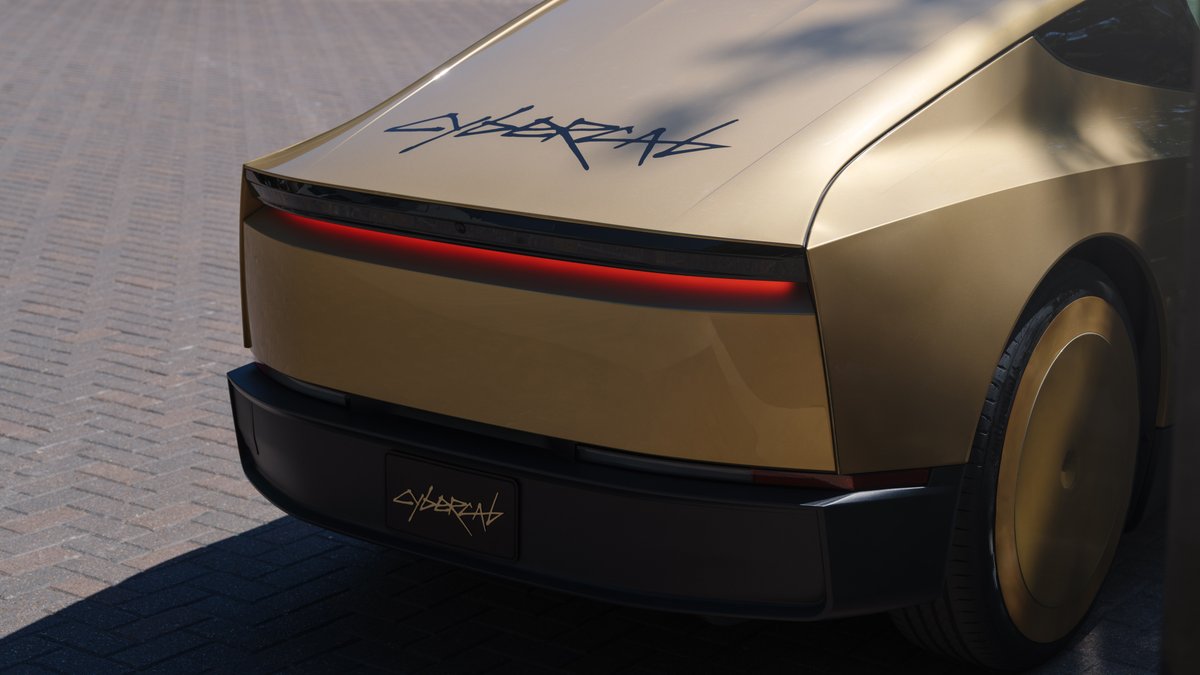
Tesla has publicly released the official Cybercab Rider Guide, and the document is more revealing than a typical compliance filing. Beyond the expected safety language, it contains hard specifications for cargo capacity, weight limits, and passenger accessibility — plus a California Proposition 65 section that's drawing attention from the Cybercab-watching community.

What the Rider Guide Actually Says
The headline numbers from the guide, surfaced by Sawyer Merritt, paint a clearer picture of the Cybercab as a practical passenger vehicle rather than a stripped-down robotaxi pod. Rear cargo capacity comes in at 20.2 cubic feet (572 liters) — a meaningful amount for a two-seat autonomous vehicle, and competitive with the trunk space of many compact sedans. The trunk is rated to hold up to 220 lb (100 kg), which covers the vast majority of real-world ride-hail use cases including luggage, groceries, and equipment.
Perhaps the most rider-friendly detail is the step-in height: just 16.5 inches. That's notably low — lower than most crossovers and comparable to a sports sedan — which should make entry and exit straightforward for passengers with limited mobility, elderly riders, and anyone carrying bags.

| Specification | Value |
|---|---|
| Rear Cargo Capacity | 20.2 cu ft (572 L) |
| Trunk Weight Limit | 220 lb (100 kg) |
| Step-In Height | 16.5 inches |
The California Proposition 65 Question
The more analytically interesting element is a dedicated California Proposition 65 section within the guide. Prop 65 requires businesses operating in California to warn consumers about significant exposures to chemicals that cause cancer, birth defects, or other reproductive harm. Its inclusion in a rider-facing document is notable — boilerplate compliance language is typically added when a product is either already operating in California or is being actively prepared for imminent deployment there.

As Teslascope noted, this lands against a backdrop of reported Cybercab sightings in Los Angeles and San Diego. Neither Tesla nor California regulators have made a formal announcement about commercial Cybercab operations in Southern California, so the Prop 65 inclusion could still be standard legal hedging — the kind of language lawyers add whenever a product might eventually reach the state. But the combination of sightings on the ground and compliance language in a public document is hard to dismiss entirely.
Why a Public Rider Guide Matters Now
The release of a formal Rider Guide is itself a signal worth noting. Tesla published the document publicly, not as an internal training tool or a regulatory filing buried in a government database. A rider-facing guide implies Tesla is preparing the Cybercab experience for a general public audience — people who haven't been briefed, who may have questions about luggage, accessibility, or what to do if something goes wrong during a ride.
The Cybercab has been operating in Austin since earlier this year, where Tesla has been expanding its unsupervised FSD robotaxi service. The existence of a polished, publicly accessible rider document suggests Tesla is moving toward a more standardized, scalable operation — one that doesn't rely on early-adopter familiarity to function smoothly.
Whether the California Prop 65 section turns out to be legal boilerplate or a genuine preview of Southern California operations, the Rider Guide itself represents a maturation of the Cybercab program. Tesla is now publishing the kind of passenger-facing documentation that any regulated transportation service needs before it can scale. The specs — generous cargo space, a high weight limit, and an unusually low step-in height — suggest the vehicle was engineered with real-world usability in mind, not just as a technology demonstrator. The next question is which city gets the next expansion after Austin.
🚕 Following the Robotaxi rollout? See every operating city, launch date and announced market in our Tesla Robotaxi Tracker.
Related Gear
Gear up your Tesla with tested, custom-fit BASENOR accessories — shop Tesla accessories →
Sources & reporting notes
The links below identify the material source records used for this report.
- @SawyerMerritt on X (2026-09-03T20:32:42.000Z) — Direct source
- @teslascope on X (2026-09-03T20:33:37.000Z) — Direct source
- @teslascope on X (2026-09-03T20:43:25.000Z) — Direct source
Source links are preserved as published or accessed. See our editorial standards and corrections policy.
The BASENOR Editorial Desk covers Tesla, SpaceX, and related technology, curating reporting from primary sources — official accounts, regulatory filings, and software release data. Every article passes source-record and fact-checking review before publication. About the newsroom.
This report was curated by the BASENOR Editorial Desk from the sources listed above. Read our editorial standards or email editorial@basenor.com to report an error.