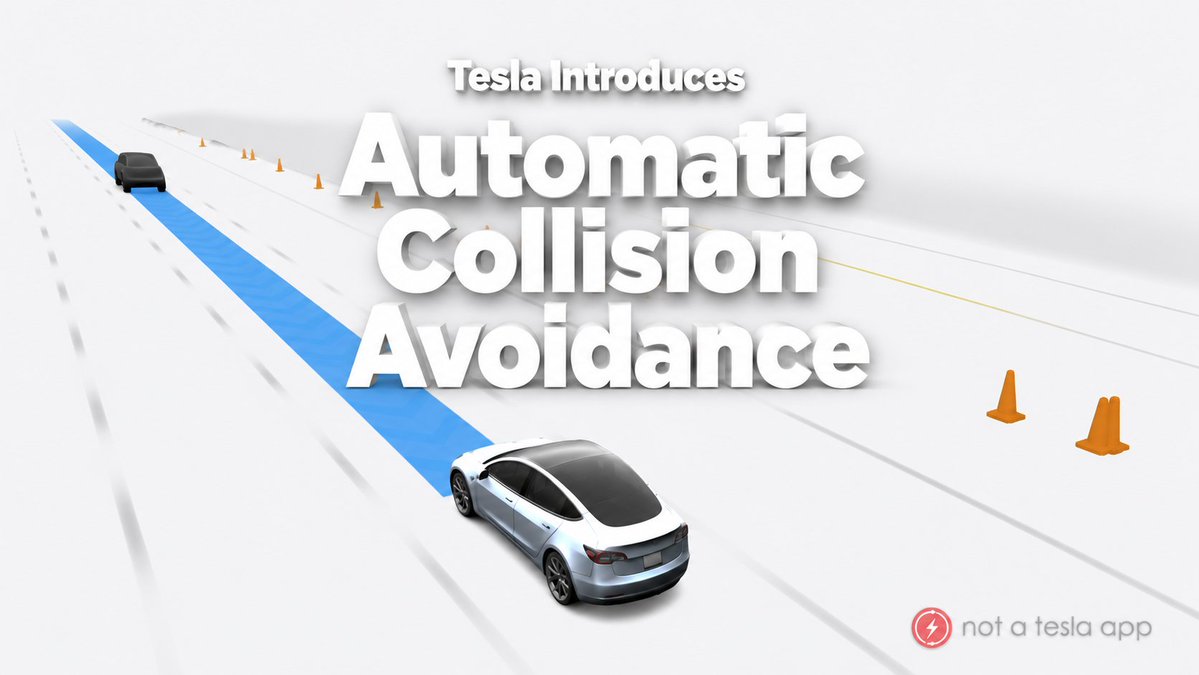
Tesla is introducing a new active safety feature called Automatic Collision Evasion that can engage Full Self-Driving (FSD) on its own to steer around an imminent crash — even when the driver hasn't activated FSD. The feature was surfaced Wednesday by longtime Tesla commentator Whole Mars Catalog, who called it a meaningful upgrade to Tesla's existing suite of passive safety systems. If you own a Tesla with FSD hardware, this is a setting you'll want to know about the moment it appears in your vehicle.

What Automatic Collision Evasion Does
According to the report from Whole Mars Catalog, Automatic Collision Evasion is a driver-selectable feature that lets the vehicle temporarily hand control to the FSD stack when the car's sensors detect an unavoidable collision is about to occur. Instead of only warning the driver or applying emergency braking — which is what Tesla's existing Automatic Emergency Braking system does — the car can now execute FSD-level evasive maneuvers such as steering around obstacles, changing lanes, or performing more complex path-planning that goes beyond a straight-line brake response.
This is a notable philosophical shift. Tesla's published safety data (as of September 30, 2025) shows that vehicles with FSD (Supervised) engaged are roughly seven times less likely to be involved in a crash than the average U.S. driver, according to Tesla's Vehicle Safety Report. Automatic Collision Evasion effectively extends that statistical benefit to moments when FSD isn't engaged — the car steps in only when it detects a crash is about to happen.
How It Fits Into Tesla's Existing Safety Stack
Tesla vehicles already ship with a layered set of active safety features that operate independently of FSD engagement, according to Tesla's owner documentation:
- Automatic Emergency Braking — applies the brakes when a frontal collision is imminent
- Forward Collision Warning — provides visual and audible alerts between roughly 3 mph and 124 mph
- Lane Departure Avoidance — applies corrective steering to keep the car in its lane
- Side Collision Avoidance — offers steering resistance when adjacent vehicles encroach
- Obstacle-Aware Acceleration — reduces throttle when obstacles are detected in the driving path
Automatic Collision Evasion sits above all of these. Where the existing systems are largely reactive and single-axis (brake OR steer), the new feature is expected to invoke the full FSD planner to choose the best evasive path — which could involve simultaneous braking, steering, and acceleration decisions that a rule-based system can't make.
Action Plan: What Tesla Owners Should Do
Since this is a new opt-in feature, here's how to prepare for it landing on your vehicle:
1. Check your software version
Open the Tesla app or go to Controls → Software in your vehicle. The feature is expected to roll out through an over-the-air update. Note the version number so you know when a new build arrives.
2. Look for the new toggle in Autopilot settings
After updating, navigate to Controls → Autopilot (or Controls → Safety, depending on how Tesla categorizes it). Watch for a new option labeled "Automatic Collision Evasion" or similar wording. Based on how Tesla has handled comparable features, expect it to be off by default — you'll need to opt in.
3. Enable it — but understand the trade-offs
When enabled, your car may briefly take control of steering in an emergency even if you haven't engaged FSD. That's the whole point of the feature, but drivers who are used to full manual control should be mentally prepared for the intervention. Read whatever consent screen Tesla presents carefully before accepting.
4. Keep your cameras clean
Every active safety feature Tesla ships depends on the vision system. Dirty pillar cameras, an obstructed forward camera, or a smeared repeater camera will degrade what the FSD stack can "see" — and therefore what Automatic Collision Evasion can do. Wipe cameras during regular washes and clear any camera obstruction warnings promptly.
5. Do not treat it as a substitute for attentive driving
Tesla is explicit that FSD (Supervised) requires active driver supervision, and Automatic Collision Evasion doesn't change that responsibility. The feature is a last-line safety net — not a reason to disengage from what's happening on the road. Continue to keep your hands on the wheel and your eyes forward.
What We Don't Know Yet
As of publication, Tesla has not released official documentation for Automatic Collision Evasion, and the feature name has not appeared in any release notes we've been able to verify independently. Open questions include:
- Hardware requirements: Will HW3 vehicles get the feature, or is it HW4-only?
- Regional rollout: North America first, or a wider release?
- FSD subscription requirement: Will you need an active FSD subscription or purchase, or will the safety-net use of FSD be available to all vehicles with the necessary hardware?
- Speed range: At what speeds will the system intervene?
We'll update this article as Tesla publishes official details or as the feature appears in a specific software build. In the meantime, the practical move for owners is straightforward: keep your car updated, watch your Autopilot settings menu after each OTA, and enable the feature when it becomes available on your vehicle.
Editor's View
If Automatic Collision Evasion works as described, it's arguably the most consequential safety feature Tesla has added since Automatic Emergency Braking itself. AEB reacts within a single axis — slow the car down. Handing control to FSD in an emergency lets the car choose from a much richer set of options, and for the split-second moments where a swerve is safer than a stop, that could genuinely save lives. The interesting wrinkle is philosophical: Tesla is essentially arguing that FSD is now safe enough to trust without driver engagement in the specific moment when a crash is otherwise unavoidable. That's a claim worth watching how regulators respond to.
Related Gear
Gear up your Tesla with tested, custom-fit BASENOR accessories — shop Tesla accessories →
Sources & reporting notes
The links below identify the material source records used for this report.
- @wholemars on X (2026-09-03T21:08:17.000Z) — Direct source
Source links are preserved as published or accessed. See our editorial standards and corrections policy.
The BASENOR Editorial Desk covers Tesla, SpaceX, and related technology, curating reporting from primary sources — official accounts, regulatory filings, and software release data. Every article passes source-record and fact-checking review before publication. About the newsroom.
This report was curated by the BASENOR Editorial Desk from the sources listed above. Read our editorial standards or email editorial@basenor.com to report an error.