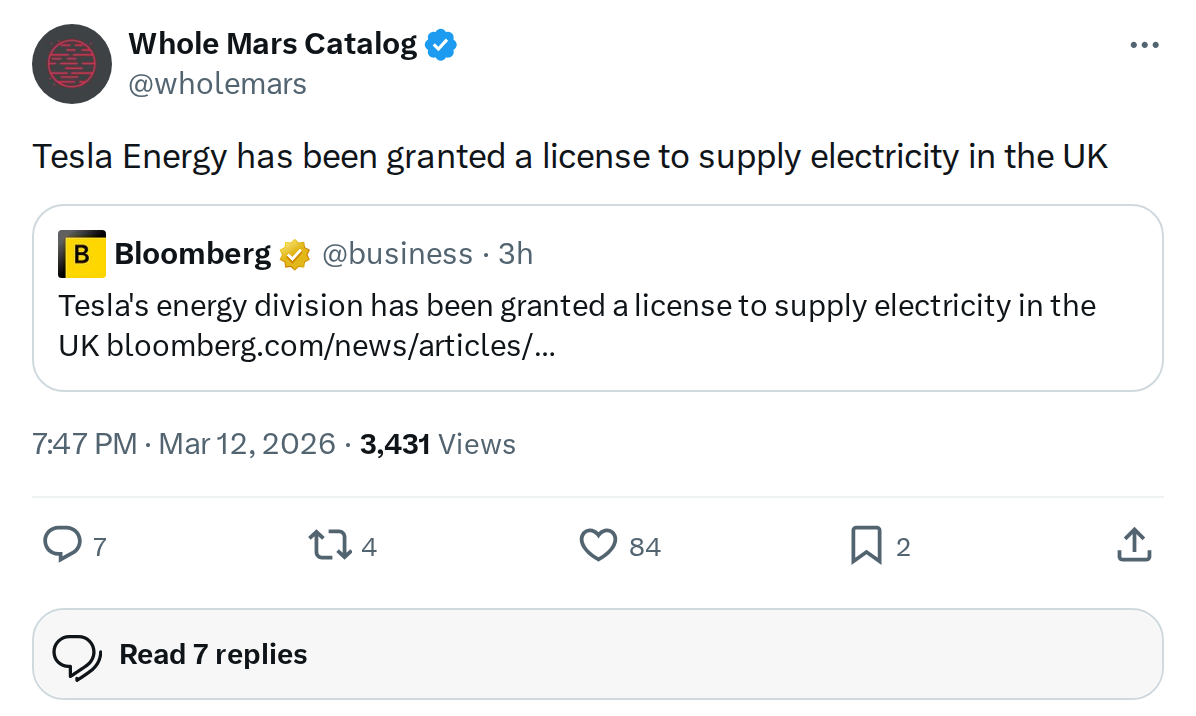
The News: Tesla Energy Ventures Limited has been granted an electricity supply license in the United Kingdom by Ofgem, effective March 11, 2026.
Why It Matters: Tesla can now sell electricity directly to UK homes and businesses — a major step toward a fully integrated Tesla energy ecosystem on British soil.
Source: @wholemars on X

📊 Key Figures
| Metric | Detail |
|---|---|
| Licensed Entity | Tesla Energy Ventures Limited |
| Regulator | Ofgem (Gas and Electricity Markets Authority) |
| Effective Date | March 11, 2026 |
| Application Period | July 2025 – March 2026 (7 months) |
| Coverage | England, Scotland, and Wales |
| Customer Types | Domestic (households) + Non-domestic (businesses) |
| UK HQ Location | Manchester |
| Gas Supply Included? | No — electricity only |
What Just Happened — and Why It Took 7 Months
Tesla Energy Ventures Limited — a UK-registered Tesla subsidiary based in Manchester — formally received its electricity supply license from Ofgem on the evening of March 11, 2026. The license was approved under the Electricity Act 1989 by the Gas and Electricity Markets Authority, the statutory body that oversees Ofgem's licensing decisions.
The application process began in July 2025 and was signed by Andrew Payne, who leads Tesla's energy business across Europe. Seven months is a fairly standard assessment window for Ofgem: new entrants must demonstrate financial resilience, operational readiness, consumer protection protocols, and billing transparency before they're permitted to trade electricity with the public. Tesla cleared every bar.
One important distinction: this is an electricity-only license. Tesla Energy Ventures is not authorized to supply gas, so this is not a dual-fuel play — at least not yet. It's also separate from an electricity generation license that was previously granted to a different Tesla entity, Tesla Motors Limited, back in June 2020. That earlier license covered generation (think solar and battery export); this new one covers retail supply directly to end customers.
📋 Regulatory Context
Authority: Ofgem / Gas and Electricity Markets Authority
Legal Basis: Electricity Act 1989
License Type: Electricity supply (retail) — not generation, not gas
Compliance Requirements: Consumer protection, fair treatment, financial responsibility, billing transparency, operational capability
Oversight: Ongoing — Ofgem retains enforcement powers post-license
🔭 The BASENOR Take
Timeline: License effective March 11, 2026 — public announcement March 12, 2026
Impact Level: 🟠 High — strategic milestone for Tesla's European energy expansion
Confidence: ✅ Confirmed — Ofgem regulatory approval is a matter of public record
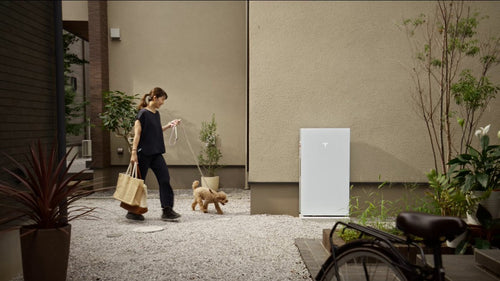
This license is the missing piece that transforms Tesla Energy from a hardware seller in the UK into a full-stack energy company. Until now, British customers could buy a Powerwall or a solar roof, but Tesla couldn't be the entity that actually supplied the electrons flowing through it. That changes now.
The strategic logic is straightforward: Tesla wants to close the loop. A UK household with a Tesla car, a Powerwall, and solar panels could theoretically have Tesla manage every watt — generation, storage, and supply — under one account. That's the Autobidder and Virtual Power Plant model that Tesla has already piloted in Australia and parts of the US, and the UK's grid structure (with its mature smart-meter rollout and flexible tariff ecosystem) is arguably an even better fit for it.
The UK energy retail market is also unusually competitive and consumer-friendly by global standards. Switching suppliers takes minutes, and price comparison is deeply embedded in consumer behavior. Tesla entering this space with a brand that UK EV drivers already trust — and with hardware already installed in tens of thousands of British homes — gives it a credible starting position that most new entrants simply don't have.
For existing UK Tesla owners with Powerwalls or solar installations, the near-term question is whether Tesla will launch tariffs specifically designed to reward battery storage — charging cheaply overnight, exporting during peak demand, and passing savings back to the customer. That's the product that would make this license genuinely disruptive, rather than just another name on an Ofgem register. Watch for a consumer-facing energy offering announcement in the months ahead.
📰 Deep Dive
Tesla's energy business has been the quieter half of the company for years, but its growth trajectory has been anything but quiet. Megapack deployments have scaled dramatically, and Powerwall demand has consistently outpaced supply in key markets. The UK license represents the next logical phase: instead of simply manufacturing and installing energy hardware, Tesla becomes the entity that monetizes that hardware through ongoing electricity supply — a recurring revenue model that Wall Street has long wanted to see formalized in Europe.
The choice of the UK as the first European market for a retail supply license is deliberate. The UK's regulatory framework, while rigorous, is well-defined. Ofgem has a clear licensing pathway, and the UK's departure from the EU means Tesla doesn't need to navigate the patchwork of 27 different national energy regulators to establish a foothold. A successful UK operation becomes the template — and potentially the legal entity — for broader European expansion under bilateral agreements.
Andrew Payne's signature on the application is also worth noting. As the executive leading Tesla's European energy business, his direct involvement signals this isn't a passive regulatory filing — it's a strategic priority with senior ownership. The seven-month timeline from application to approval suggests Tesla came to Ofgem well-prepared, with the financial and operational documentation that regulators require for new market entrants.
For UK Tesla owners specifically: nothing changes overnight. Tesla Energy Ventures now has the legal right to supply electricity, but launching a consumer tariff product requires additional infrastructure — billing systems, customer service operations, and likely partnerships with grid balancing entities. The license is the starting gun, not the finish line. But it's a starting gun that's been a long time coming, and the race is now officially on.
Related Gear
Gear up your Tesla with tested, custom-fit BASENOR accessories — shop Tesla accessories →
Sources & reporting notes
The links below identify the material source records used for this report.
- @wholemars on X (2026-03-12T11:47:46.000Z) — Direct source
Source links are preserved as published or accessed. See our editorial standards and corrections policy.
The BASENOR Editorial Desk covers Tesla, SpaceX, and related technology, curating reporting from primary sources — official accounts, regulatory filings, and software release data. Every article passes source-record and fact-checking review before publication. About the newsroom.
This report was curated by the BASENOR Editorial Desk from the sources listed above. Read our editorial standards or email editorial@basenor.com to report an error.