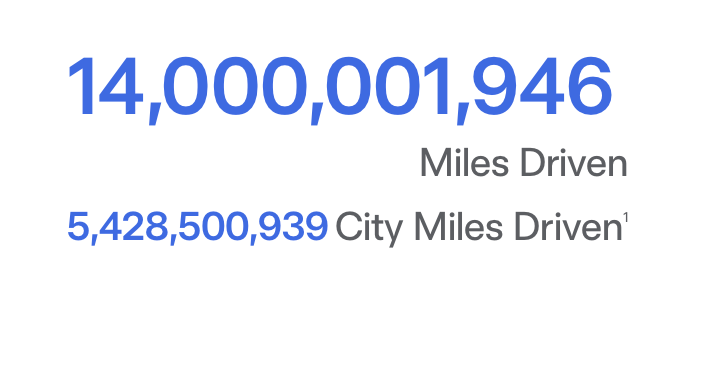
Tesla's Full Self-Driving (Supervised) system crossed 14 billion cumulative miles traveled on August 27, 2026 — a milestone that arrived just 24 days after the system passed 13 billion. The pace of accumulation is accelerating, and the numbers behind it tell a story about where FSD stands heading into the next phase of autonomous deployment.

The Pace Is the Story
The jump from 13 billion to 14 billion miles happened in roughly 24 days. For context, between August 3 and August 20 alone — a 17-day window — Tesla's fleet logged approximately 600 million additional FSD miles, according to tracking data. That works out to roughly 35 million miles per day during that stretch.
The acceleration isn't accidental. Tesla's FSD subscriber base has grown significantly, with approximately 1.5 million monthly active users recorded in Q2 2026. A subscription price cut to $99 per month in February 2026 almost certainly expanded that pool. More active users means more miles, which means more edge-case data fed back into training — a compounding loop that gets harder for competitors to replicate without a comparable installed base.
| Milestone | Date | Days Since Prior Billion |
|---|---|---|
| 13 billion miles | August 3, 2026 | — |
| 14 billion miles | August 27, 2026 | 24 days |
Global Reach Is Widening
The mileage accumulation is no longer a North American story. As of August 26, Tesla's European fleet had logged over 100 million kilometers (roughly 62 million miles) on FSD Supervised. South Korean owners have collectively driven more than 50 million kilometers (approximately 31 million miles) on the system. FSD is now available in 12 markets as of August 2026, and each new region adds both miles and geographically diverse training scenarios — dense urban environments, different road markings, varied traffic behavior — that a purely domestic dataset wouldn't capture.
Reliability Benchmark Worth Noting
Alongside the mileage milestone, Tesla highlighted a reliability figure on August 10: the FSD Supervised system can now drive over 25,000 miles between driver interventions. That number matters because intervention rate — not total miles — is the metric that most directly maps to real-world safety performance. A fleet accumulating 35 million miles per day at 25,000 miles per intervention represents a very different operational reality than early FSD builds that required corrections every few miles.
The current generation running these miles spans FSD v14 and the v14 "lite" build extended to Hardware 3 vehicles, according to background research. Bringing HW3 owners — a substantial portion of the installed base — into active FSD usage was a meaningful lever for accelerating total accumulation.
What 14 Billion Miles Actually Means
Raw mileage figures can feel abstract, but they represent something concrete in machine learning terms: exposure to scenarios the model has never seen before. The long tail of rare driving situations — unusual intersections, unexpected pedestrian behavior, edge-case weather — requires enormous real-world scale to encounter with any statistical regularity. At 14 billion miles and climbing, Tesla's dataset dwarfs what any simulation-only or limited-deployment approach can generate in comparable timeframes.
Whether that data advantage translates directly into a faster path to unsupervised autonomy remains the open question. Tesla has consistently used cumulative mileage as a proxy for training progress, and the current rate of accumulation — trending toward a new billion miles every three weeks — means the gap between 14 billion and whatever the next meaningful threshold is will close faster than any previous interval. The 15 billion mark, at current pace, is likely weeks away.
Related Gear
Gear up your Tesla with tested, custom-fit BASENOR accessories — shop Tesla accessories →
Sources & reporting notes
The links below identify the material source records used for this report.
- @wholemars on X (2026-08-31T07:17:00.000Z) — Direct source
Source links are preserved as published or accessed. See our editorial standards and corrections policy.
The BASENOR Editorial Desk covers Tesla, SpaceX, and related technology, curating reporting from primary sources — official accounts, regulatory filings, and software release data. Every article passes source-record and fact-checking review before publication. About the newsroom.
This report was curated by the BASENOR Editorial Desk from the sources listed above. Read our editorial standards or email editorial@basenor.com to report an error.