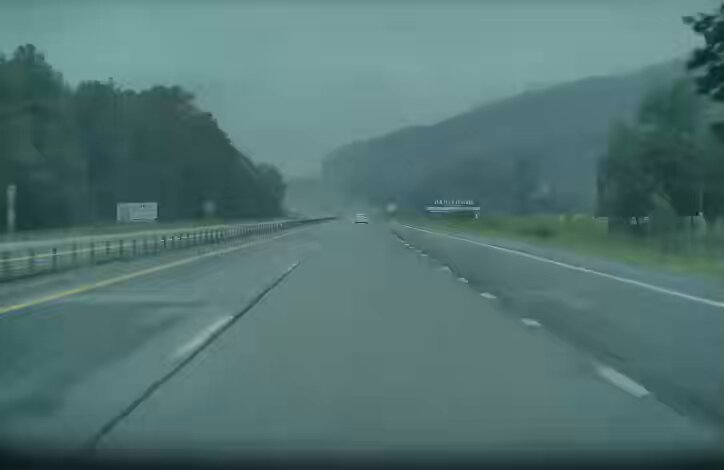
The News: Tesla FSD (Supervised) detected and avoided a pedestrian at over 65 mph (105+ km/h) in heavy fog and rain — conditions that would challenge any driver.
Why It Matters: This real-world incident is one of the most dramatic demonstrations yet of FSD's adverse-weather pedestrian avoidance, with the reporter stating it saved both lives involved.
Source: @TeslaNewswire on X
When the Driver Couldn't See, FSD Could
Heavy fog and rain at highway speed is one of the most dangerous combinations a driver can face. Visibility drops, reaction time shrinks, and a pedestrian on or near the roadway becomes nearly invisible until it's too late. In a video shared by The Tesla Newswire, Tesla's FSD (Supervised) system encountered exactly that scenario — and reacted before any human behind the wheel realistically could have.
The system detected a pedestrian at over 65 mph (105+ km/h) and executed an avoidance maneuver in conditions where human perception would have been severely compromised. According to the report, both the pedestrian and the driver walked away unharmed.

What Made This Save Possible
This incident didn't happen in isolation. It reflects a series of deliberate capability advances Tesla has been building into FSD over the past several months.
The most relevant is pedestrian intent prediction, a feature integrated into FSD v14 (running on the 2026.2 software branch) and officially announced around March 28, 2026. Rather than waiting for a pedestrian to step into the road before braking — the reactive approach — FSD now anticipates the intent to enter the roadway before it happens. In a high-speed scenario like this one, that difference in timing is the difference between a near-miss and a fatality.
The adverse weather performance is equally significant. Tesla AI officially released footage in February 2026 demonstrating FSD navigating heavy rain and flooded roads, and a separate video from March 2026 showed the system operating in dense fog with the driver in a fully supervisory role. The pedestrian avoidance clip shared today represents both of those capabilities converging in a single, high-stakes real-world moment.
FSD (Supervised) uses a camera-based neural network rather than lidar. Critics have long questioned whether cameras alone can perform reliably in low-visibility conditions. This footage adds to a growing body of evidence that the system's training data now includes enough adverse-weather scenarios to handle them at speed — though it's worth noting that FSD (Supervised) still requires an attentive driver ready to intervene at all times.
📊 Key Figures
| Metric | Value | Context |
|---|---|---|
| Avoidance speed | 65+ mph (105+ km/h) | Highway speed in fog and rain |
| FSD max engagement speed | 85 mph | System was within operational envelope |
| FSD collision reduction vs. manual | 7x fewer (major/minor) | Per Tesla Vehicle Safety Report |
| Pedestrian intent prediction | FSD v14 / 2026.2 | Announced March 28, 2026 |
| FSD subscription price | $99/month | As of February 14, 2026 |
🔭 The BASENOR Take
Timeline: FSD v14 pedestrian intent prediction announced March 28, 2026 → Heavy rain navigation footage released February 2026 → Dense fog operation documented March 2026 → This high-speed pedestrian avoidance in combined fog/rain, April 6, 2026
Impact Level: 🔴 High — Real-world life-safety outcome, not a controlled demo
Confidence: Video evidence shared publicly. Specific circumstances (road type, exact weather severity) are unverified beyond the clip. Tesla has not issued an official statement on this incident.
A few things stand out about this clip beyond the headline. First, the conditions: fog and rain together are genuinely among the worst-case scenarios for any vision-based system. The fact that FSD not only detected the pedestrian but executed a clean avoidance at highway speed suggests the neural network's adverse-weather training has matured considerably since early FSD versions that struggled with basic lane keeping in rain.
Second, the speed. At 65+ mph, a human driver's stopping distance in wet conditions is roughly 300+ feet. The window for a reactive response to a pedestrian suddenly appearing in limited visibility is measured in fractions of a second. FSD's camera array and onboard compute processed the scene and acted within that window — something the average human driver, however attentive, would struggle to replicate.
Third, timing matters here. With FSD's European debut expected imminently — approval in the Netherlands was anticipated around April 10, 2026 — footage like this carries weight beyond the individual incident. Regulators evaluating the system will be watching exactly these kinds of real-world edge cases. A documented save in fog and rain at highway speed is a stronger argument than any lab test.
The reminder that FSD (Supervised) still requires an alert driver is not a caveat to be glossed over. The system is not autonomous. But moments like this one illustrate why Tesla's safety data — showing 7x fewer major and minor collisions compared to manually driven Teslas — is increasingly difficult to dismiss. For our FSD coverage, this is one of the most compelling real-world data points of 2026 so far.
📋 Tracking Tesla software? See every firmware, FSD and app version in one place in our Tesla Software Update Tracker.
Related Gear
Gear up your Tesla with tested, custom-fit BASENOR accessories — shop Tesla accessories →
Sources & reporting notes
The links below identify the material source records used for this report.
- @TeslaNewswire on X (2026-04-06T18:39:39.000Z) — Direct source
Source links are preserved as published or accessed. See our editorial standards and corrections policy.
The BASENOR Editorial Desk covers Tesla, SpaceX, and related technology, curating reporting from primary sources — official accounts, regulatory filings, and software release data. Every article passes source-record and fact-checking review before publication. About the newsroom.
This report was curated by the BASENOR Editorial Desk from the sources listed above. Read our editorial standards or email editorial@basenor.com to report an error.