30-Second Brief
The News: Tesla's Full Self-Driving system is slowing for pedestrians hidden between parked cars — before the human driver has any idea they're there.
Why It Matters: This is predictive perception, not reactive braking — a meaningful leap in what FSD can do that directly affects every owner using the system today.
Source: @wholemars on X
Tesla FSD Sees Pedestrians Before You Do — Here's the Proof
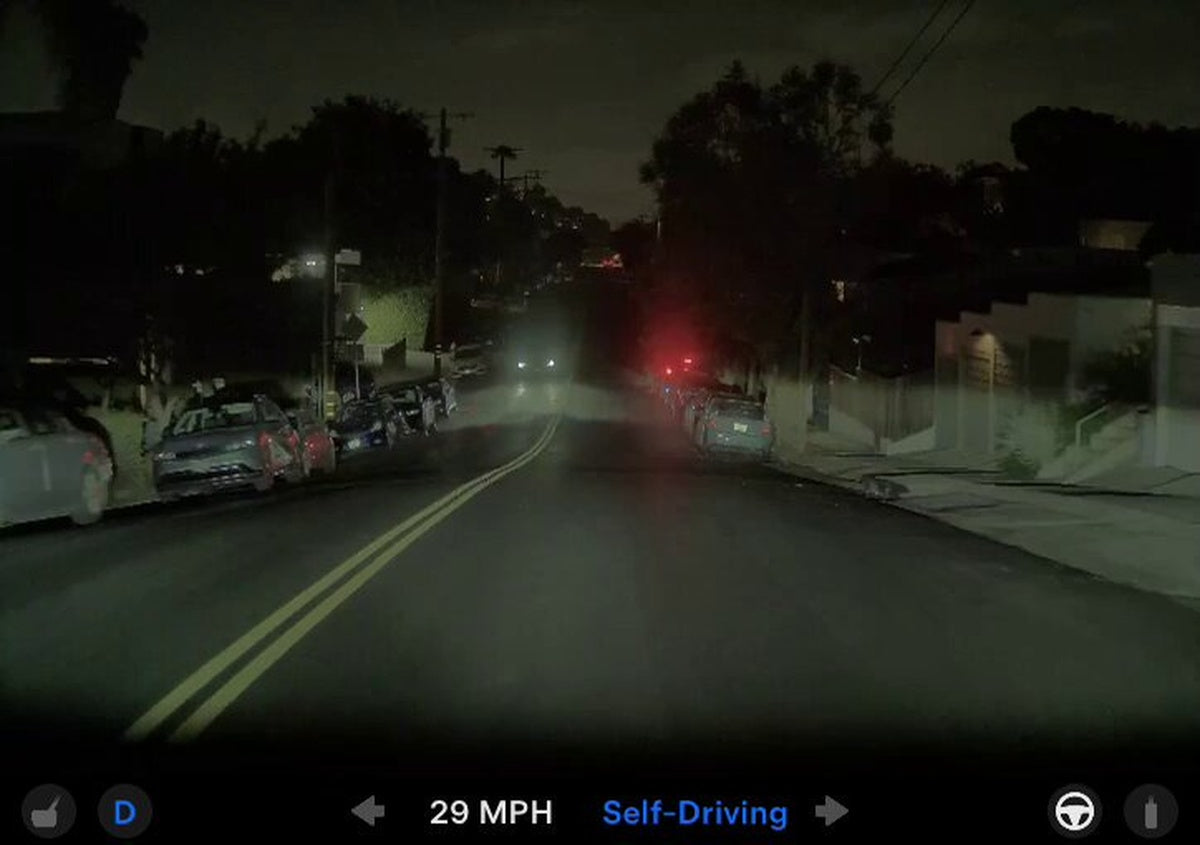
Three clips posted this morning by prolific Tesla tester Whole Mars Catalog (@wholemars) are making the rounds for good reason. In the most striking example, Tesla's Full Self-Driving system began decelerating for a pedestrian who was still completely hidden between two parked cars. The driver didn't see him. The passenger didn't see him. The car did — and it acted first.
That's not a dashcam near-miss. That's FSD operating ahead of human perception. And it's happening right now, on public roads, in the current software build.
What You're Seeing in These Clips
The three videos capture distinct scenarios, each demonstrating a different layer of FSD's situational awareness:
Clip 1 — Lane Positioning for a Merging Vehicle: FSD moved the car laterally to create space for another vehicle before the driver had registered its presence. No prompt, no hesitation — the system identified the trajectory of the other car and adjusted proactively.

Clip 2 — Expecting the Unexpected: A broader demonstration of FSD anticipating an ambiguous situation and positioning itself conservatively before any threat materialized. The caption says it plainly: "Tesla Self-Driving expects the unexpected."

Clip 3 — The Pedestrian Behind Parked Cars: This is the one that's generating the most reaction. FSD slowed before a pedestrian stepped out from between parked vehicles. The occupants only understood why the car had decelerated after the pedestrian appeared. @wholemars called it "legitimately" mind-blowing and "indisputably superhuman." Hard to argue.

📊 What's Driving This Capability
These clips aren't random flukes. They reflect specific architectural changes baked into the FSD v14.x software branch. Here's what's relevant:
| Improvement | What It Does |
|---|---|
| Neural network rewritten with MLIR | 20% faster reaction time across all FSD decisions |
| Upgraded vision encoder | Better 3D geometry understanding, improved detection in rare and low-visibility scenarios |
| Pedestrian intent prediction | FSD can now anticipate a pedestrian's intent to enter the road before they step off the curb — reactive braking replaced by proactive prediction |
| Reinforcement Learning upgrades | Trained on harder examples sourced from the Tesla fleet, including rare objects extending into the vehicle's path |
| Unified model (FSD + Summon + Robotaxi) | Single neural network powering all autonomous modes for more consistent, reliable behavior |
The pedestrian prediction capability specifically — anticipating movement before the person has physically stepped into the road — is part of the 2026.2 software branch and is tied directly to the upgraded vision encoder and RL training improvements.
🚦 Owner's Action Plan
Verdict: RECOMMENDED — Check your software version and FSD settings
Step 1 — Confirm you're on the latest FSD build. The capabilities shown in these clips are part of FSD v14.3.2, included in firmware 2026.2.9.8 (released April 23, 2026). Go to Controls → Software to check your current version. If an update is pending, install it.
Step 2 — Verify your hardware eligibility. FSD v14.x is currently rolling out to vehicles with Hardware 4 (AI4). If you're on Hardware 3 (HW3), a "lite" version of FSD v14 is confirmed for release by end of June 2026 — it will include the majority of AI4 features, though unsupervised operation won't be possible on HW3 due to hardware memory bandwidth limitations.
Step 3 — Enable FSD on urban routes where this matters most. Pedestrian-dense environments — parking lots, residential streets, school zones — are exactly where predictive perception provides the most safety margin. If you've been hesitant to use FSD in these areas, the current build is worth re-evaluating.
Step 4 — Stay engaged regardless. Tesla's official designation remains "Full Self-Driving (Supervised)." The system requires active driver supervision and you must remain ready to intervene at all times. These clips show impressive capability — not a reason to look away from the road.
Step 5 — Watch for the unsupervised FSD rollout timeline. Elon Musk stated during the Q1 2026 earnings call that a gradual rollout of unsupervised FSD for consumer vehicles is anticipated to begin in Q4 2026, starting in validated geographies. The predictive capabilities being demonstrated now are the foundation for that milestone. For more on our FSD coverage, see our full archive.
📰 Deep Dive
What separates the pedestrian clip from typical FSD praise content is the specificity of the scenario. Detecting a pedestrian who is actively visible — crossing a street, standing on a curb — is a solved problem for modern ADAS systems. Detecting a pedestrian who is still occluded, inferring their likely trajectory from partial visual data and behavioral cues, and initiating a deceleration response before the human occupants have any awareness of the threat — that's a qualitatively different capability. It's the difference between a system that reacts and a system that anticipates.
The underlying mechanism is the upgraded vision encoder introduced in the FSD v14 branch. By improving 3D geometry understanding and training the neural network on rare, hard-to-classify scenarios sourced from Tesla's global fleet, the system has developed what amounts to predictive spatial reasoning. It's not seeing through cars — it's inferring, from the movement patterns and partial silhouettes available to its cameras, that something is about to enter the roadway. The 20% faster neural network reaction time from the MLIR rewrite means that inference translates to vehicle action faster than before.
The practical implication for owners is straightforward: FSD is now catching edge cases that human drivers routinely miss. Parked cars obscuring pedestrians is one of the most common scenarios in pedestrian fatality statistics. A system that can anticipate that scenario rather than react to it represents a genuine safety delta over human-only driving — at least in the conditions shown in these clips. Whether that holds across all environments, weather conditions, and traffic densities at scale is the question that the ongoing supervised rollout is designed to answer.
With unsupervised FSD targeted for Q4 2026, Tesla needs to demonstrate exactly this kind of capability — consistently, not just in cherry-picked clips. Today's videos are compelling evidence that the underlying technology is maturing. The next test is whether it holds up at fleet scale.
📋 Tracking Tesla software? See every firmware, FSD and app version in one place in our Tesla Software Update Tracker.
Related Gear
Gear up your Tesla with tested, custom-fit BASENOR accessories — shop Tesla accessories →
Sources & reporting notes
The links below identify the material source records used for this report.
- @wholemars on X (2026-04-25T08:09:17.000Z) — Direct source
- @wholemars on X (2026-04-25T08:06:32.000Z) — Direct source
- @wholemars on X (2026-04-25T08:05:04.000Z) — Direct source
Source links are preserved as published or accessed. See our editorial standards and corrections policy.
The BASENOR Editorial Desk covers Tesla, SpaceX, and related technology, curating reporting from primary sources — official accounts, regulatory filings, and software release data. Every article passes source-record and fact-checking review before publication. About the newsroom.
This report was curated by the BASENOR Editorial Desk from the sources listed above. Read our editorial standards or email editorial@basenor.com to report an error.