📌 UPDATE — April 7, 2026
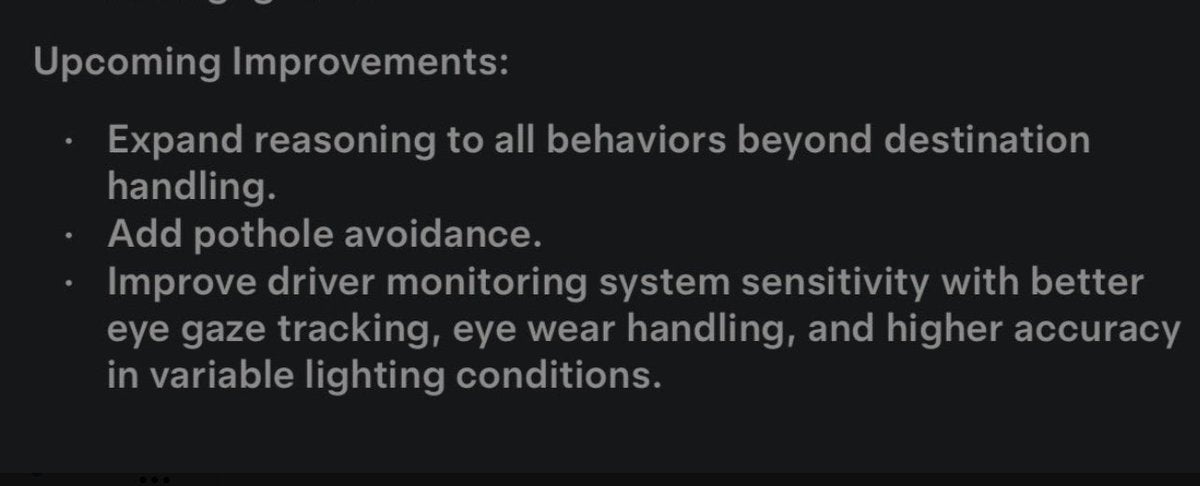
Teslascope has now confirmed the official release notes for FSD (Supervised) V14.3, giving us our clearest look yet at what's coming. The update locks in three key improvements: reasoning capabilities expanded beyond destination handling to cover all behaviors, a new pothole avoidance feature, and a more sensitive driver monitoring system with better eye gaze tracking and improved handling of eyewear. Teslascope also previewed how the V14.3 release notes will appear in their upcoming mobile app, suggesting the rollout may be close.


30-Second Brief
The News: Tesla's FSD release notes list three major upcoming improvements — pothole avoidance, expanded neural net reasoning across all driving behaviors, and a significantly upgraded driver monitoring system.
Why It Matters: These aren't incremental tweaks. Pothole avoidance directly protects your wheels and suspension. Expanded reasoning means FSD handles edge cases it previously fumbled. And tighter driver monitoring means fewer false alerts — and fewer unnecessary disengagements.
Source: @SawyerMerritt on X
Tesla FSD Is Getting Pothole Avoidance, Smarter Reasoning, and Better Driver Monitoring
Tesla has quietly listed three significant Full Self-Driving improvements under "Upcoming" in its FSD v14.3 release notes — and each one addresses a real pain point that owners have flagged for years. Sawyer Merritt surfaced the details today, and the roadmap is more concrete than the usual vague promises.

Here's what's confirmed as "upcoming" in the FSD pipeline — and what each improvement actually means for your daily drive.
🕳️ Pothole Avoidance: Your Wheels Will Thank You
This is the one that'll get the most attention — and rightfully so. Pothole avoidance is explicitly listed as an upcoming addition in the FSD v14.3 release notes. The feature would allow FSD to detect road surface hazards and actively steer around them, rather than driving straight through.
It's worth noting that earlier FSD versions — including v12.3.4 and v14.2.2.5 — have already shown early signs of this behavior in the wild. Owners have captured footage of FSD slowing before potholes or making subtle lateral adjustments. That was emergent behavior from the neural network, not an engineered feature. What's coming next appears to be a deliberate, trained capability — not a happy accident.
The real-world stakes are significant. Pothole damage costs U.S. drivers billions annually in suspension and tire repairs. For a vehicle as heavy as a Model Y or Cybertruck, hitting a deep pothole at speed isn't just uncomfortable — it's expensive. A system that can reliably detect and avoid them is a genuine quality-of-life upgrade, not just a demo trick.
🧠 Expanded Reasoning: FSD Stops Being a One-Trick Thinker
The second improvement is arguably the most technically significant: expanding reasoning capabilities to "all behaviors beyond destination handling."
To understand why this matters, you need to know where reasoning currently lives in FSD. Right now, the reasoning layer — the part of the neural network that thinks through complex scenarios rather than pattern-matching — is primarily applied to route planning and destination logic. Everything else (lane changes, merges, intersections, pedestrian interactions) runs on a more reactive, pattern-based approach.
Expanding reasoning across all driving behaviors means FSD would apply deliberate, multi-step thinking to the kinds of edge cases that currently trip it up: the cyclist who suddenly swerves, the construction zone with contradictory signals, the four-way stop where everyone arrives simultaneously. Tesla VP of AI Software Ashok Elluswamy has previously confirmed this direction, noting that reasoning integration is specifically designed to handle complex and unforeseen scenarios.
FSD v14.3 is also expected to incorporate a significantly larger neural network with improved reinforcement learning capabilities — the architecture that makes this reasoning expansion possible. The end-to-end neural net approach introduced with FSD v12 in late 2023 laid the groundwork; this is the next major step on that foundation. For more context on where FSD is headed, see our FSD coverage.
👁️ Driver Monitoring: Fewer False Alerts, Higher Accuracy
The third improvement targets a frustration that's driven some owners to game the system rather than work with it: the driver monitoring system (DMS) that watches whether you're paying attention while FSD is active.
The upcoming changes are specific:
- Better eye gaze tracking — more accurate detection of where you're actually looking, reducing false positives when you glance at mirrors or check blind spots
- Enhanced eyewear handling — improved performance for drivers wearing glasses or sunglasses, which currently confuse the cabin camera more than Tesla would like to admit
- Higher accuracy in variable lighting — better performance at dawn, dusk, and in tunnels, where the current system struggles to reliably read facial cues
Tesla's DMS uses the interior cabin camera — positioned above the rearview mirror — to monitor driver attentiveness. The system is a regulatory and safety requirement for any Level 2 ADAS system, but its current implementation generates enough false alerts that some owners find it more annoying than helpful. A more accurate DMS means fewer unwarranted warnings, which paradoxically should improve safety: drivers who aren't constantly dismissing false alerts are more likely to take genuine warnings seriously.
📊 Key Figures
| Detail | Value | Context |
|---|---|---|
| FSD version | v14.3 | In employee beta as of April 7, 2026 |
| Wide release target | ~End of week (Apr 11) | Per Elon Musk, April 1, 2026 |
| Hardware priority | HW4 first | HW3 gets "FSD v14 Lite" ~mid-2026 |
| Upcoming improvements listed | 3 confirmed | Pothole avoidance, reasoning expansion, DMS upgrade |
🔭 The BASENOR Take
Timeline: FSD v14.3 wide release expected by ~April 11, 2026 (HW4). HW3 owners: mid-2026 for FSD v14 Lite.
Impact Level: High — these changes affect every FSD user's daily experience
Confidence: High — sourced directly from FSD v14.3 release notes "Upcoming Improvements" section
What stands out about this roadmap is the coherence of the three improvements together. Pothole avoidance, expanded reasoning, and better driver monitoring aren't random feature additions — they're all part of the same underlying push: making FSD feel less like a system you're managing and more like one that's genuinely competent.
The reasoning expansion is the one to watch most closely. Current FSD is impressive in structured environments but still brittle at the edges — the weird intersection, the unexpected road closure, the pedestrian doing something unpredictable. Applying the reasoning layer across all driving behaviors, not just route planning, is the architectural change that could close that gap significantly.
HW4 owners are first in line and should watch for the v14.3 wide release in the coming days. HW3 owners will need to wait for the "FSD v14 Lite" build, which Tesla has indicated is targeting mid-2026. The pothole avoidance and DMS improvements are likely to ship in v14.3 or a near-term follow-on; the full reasoning expansion may roll out incrementally as the larger neural network is validated at scale.
Bottom line: if you've been on the fence about whether FSD is worth using regularly, these three improvements — especially the DMS accuracy upgrade — directly address the friction points that make the current experience feel high-maintenance. The next few months of FSD development look more substantive than anything since the v12 end-to-end rewrite.
📋 Tracking Tesla software? See every firmware, FSD and app version in one place in our Tesla Software Update Tracker.
Related Gear
Gear up your Tesla with tested, custom-fit BASENOR accessories — shop Tesla accessories →
Sources & reporting notes
The links below identify the material source records used for this report.
- @SawyerMerritt on X (2026-04-07T19:59:11.000Z) — Direct source
- @teslascope on X (2026-04-07T20:05:51.000Z) — Direct source
- @TeslaNewswire on X (2026-04-07T20:39:35.000Z) — Direct source
Source links are preserved as published or accessed. See our editorial standards and corrections policy.
The BASENOR Editorial Desk covers Tesla, SpaceX, and related technology, curating reporting from primary sources — official accounts, regulatory filings, and software release data. Every article passes source-record and fact-checking review before publication. About the newsroom.
This report was curated by the BASENOR Editorial Desk from the sources listed above. Read our editorial standards or email editorial@basenor.com to report an error.