📌 UPDATE — April 9, 2026
🔍 The crackdown on unauthorized FSD access appears to be hitting European users hard. Prominent Tesla commentator Whole Mars Catalog posted on X that "the fun is over for people using FSD in Europe," suggesting Tesla has rolled out new enforcement measures targeting the region. While official confirmation from Tesla is still pending, the post — accompanied by what appears to be evidence of the restriction — signals that the remote disable measures previously reported are now being more broadly and aggressively applied across Europe. European owners who had been accessing FSD through workaround devices should expect their access to be revoked imminently, if it hasn't been already.

30-Second Brief
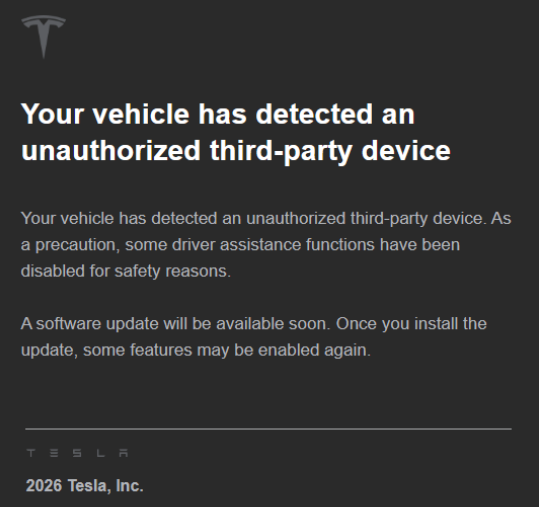
The News: Tesla has remotely disabled certain Full Self-Driving (Supervised) driver assistance functions on customer vehicles in unsupported regions, following unauthorized device use that bypassed regional restrictions.
Why It Matters: If you drive a Tesla in a region where FSD is not officially supported, some driver assistance features may already be gone — and the reason is both a safety and a regulatory one.
Source: @teslascope on X
Tesla Remotely Disables FSD (Supervised) in Unsupported Regions — Here's What Owners Need to Know
Tesla has taken direct action against unauthorized use of Full Self-Driving (Supervised) in regions where the software is not officially approved. The company remotely disabled certain driver assistance functions on affected vehicles — and if you're in an unsupported region, this change may already be on your car.

📊 What Changed
| Aspect | Before | After |
|---|---|---|
| FSD Access (Unsupported Regions) | Accessible via unauthorized third-party devices | Remotely disabled by Tesla |
| Driver Assistance Features | Partially functional through bypass | Some functions disabled remotely |
| Traffic Law Compliance | Not designed for local traffic laws or signals | Risk removed via remote disable |
| Future Restoration | N/A | Some features to be restored in a future update, pending regulatory progress |
Why Tesla Pulled the Trigger
This isn't a routine software rollback. Tesla's action is a direct response to unauthorized devices — third-party hardware or software tools — that were being used to activate FSD (Supervised) in regions where Tesla has not received regulatory approval to offer the feature.
The core problem, as Teslascope explains, is that FSD (Supervised) was never designed to respect local traffic laws, traffic light configurations, road markings, or regional driving norms in these unsupported markets. Even with a human supervisor behind the wheel, running software that doesn't understand local road rules introduces meaningful safety risk.

Tesla's decision to act remotely — pushing a disable over the air — signals that the company is actively monitoring for unauthorized bypass activity and is willing to intervene directly on customer vehicles when safety or regulatory compliance is at stake. This is a significant use of Tesla's remote vehicle management capability.
The Road to European FSD Approval
The timing matters. Teslascope notes that 2026 is a pivotal year for Tesla's regulatory push in Europe, and the company has already shared progress toward approvals in European countries. A prior update on March 19th was flagged as part of this ongoing process, with more expected throughout the year.

Tesla has confirmed that some of the disabled features will be restored in a future update. The implication is clear: as regulatory approvals are secured region by region, FSD capabilities will be re-enabled through official channels — not through third-party workarounds. For more on Tesla's self-driving progress, see our FSD coverage.
🚦 Owner's Action Plan
⚠️ Verdict: ESSENTIAL — If you are in an unsupported region and have used a third-party device to access FSD, read this carefully.
- Check your driver assistance features. Open your Tesla's Autopilot settings and verify which features are currently active. If you've noticed any functions missing since April 8, 2026, this remote disable is likely the cause.
- Do not attempt to re-enable via unauthorized devices. Tesla is actively monitoring for bypass activity. Further attempts may result in additional restrictions or warranty implications.
- Remove any third-party bypass hardware or software. Unauthorized devices that were used to activate FSD in unsupported regions are the direct cause of this action. Continued use poses both safety and account risks.
- Monitor Tesla's official communications. Tesla has indicated that some features will be restored in a future update. Watch for OTA release notes that reference driver assistance restoration for your region.
- Check your region's regulatory status. If you are in Europe, Tesla is actively pursuing regulatory approval. The timeline for official FSD access in your country will depend on that approval process — not on third-party tools.
- Contact Tesla Support if needed. If you believe features have been incorrectly disabled on your vehicle and you are in a supported region, reach out to Tesla Support directly through the app.
📰 Deep Dive
Tesla's remote disable of FSD features in unsupported regions is a reminder of something that often goes undiscussed: Tesla retains the ability to modify — or remove — software features on your vehicle at any time via over-the-air updates. This has always been part of the Tesla ownership model, but it's rarely exercised in a way that directly removes functionality owners were actively using, even if that use was unauthorized.
The safety argument here is legitimate. FSD (Supervised) is trained and validated against specific regional datasets — traffic laws, signal configurations, lane markings, and driving conventions that vary significantly between markets. A system that performs well in the United States may not correctly interpret a roundabout priority rule in France or a unique traffic signal sequence in Germany. Running that system in unsupported regions, even with a driver supervising, introduces unpredictable edge cases that Tesla's safety team clearly considers unacceptable.
For owners in unsupported regions who were using these features through bypass devices, the frustration is understandable — the underlying hardware capability was there, and the software was functionally operational. But Tesla's position is that regulatory approval isn't just a bureaucratic checkbox; it's the process through which the software gets validated against local conditions. Skipping that process, even with a supervisor in the seat, is the gap that prompted this action.
The positive signal buried in this story is the forward-looking one: Tesla explicitly says some features will return in a future update, and Teslascope notes that regulatory progress in Europe is already underway. For owners waiting on official FSD access in their region, 2026 looks like the year to watch.
Related Gear
Gear up your Tesla with tested, custom-fit BASENOR accessories — shop Tesla accessories →
Sources & reporting notes
The links below identify the material source records used for this report.
- @teslascope on X (2026-04-08T23:36:53.000Z) — Direct source
- @teslascope on X (2026-04-08T23:36:53.000Z) — Direct source
- @teslascope on X (2026-04-08T23:36:52.000Z) — Direct source
- @wholemars on X (2026-04-09T04:36:06.000Z) — Direct source
Source links are preserved as published or accessed. See our editorial standards and corrections policy.
The BASENOR Editorial Desk covers Tesla, SpaceX, and related technology, curating reporting from primary sources — official accounts, regulatory filings, and software release data. Every article passes source-record and fact-checking review before publication. About the newsroom.
This report was curated by the BASENOR Editorial Desk from the sources listed above. Read our editorial standards or email editorial@basenor.com to report an error.