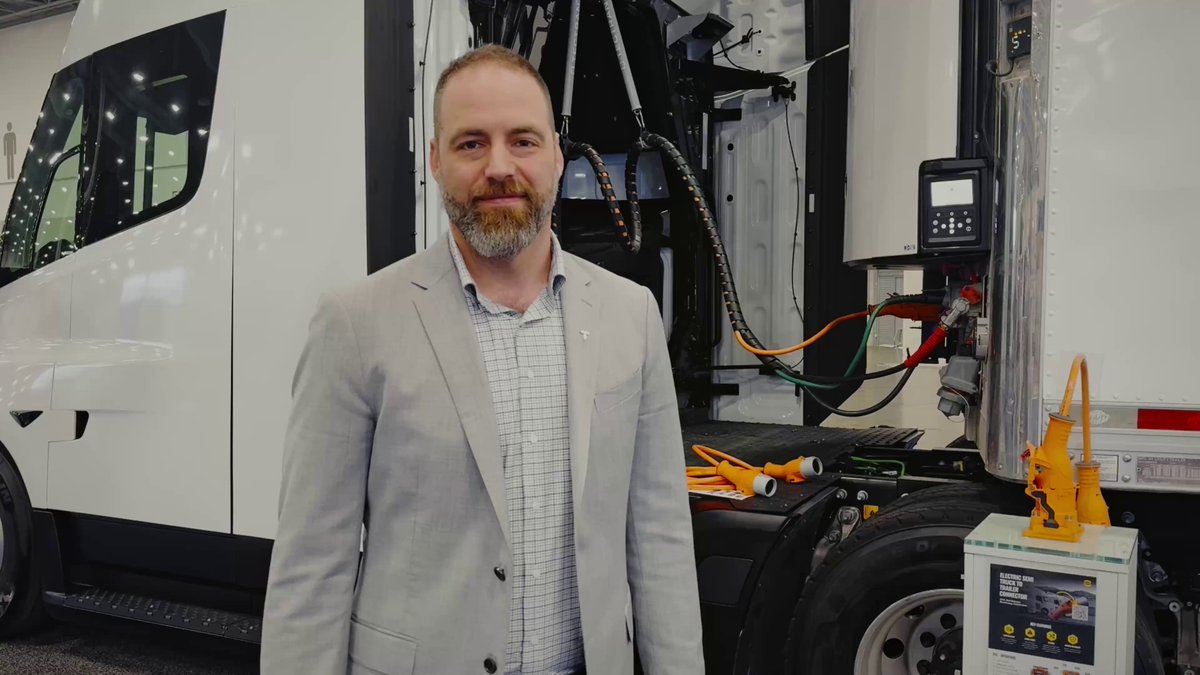
Tesla has published a new video featuring Dan Priestley, Senior Manager of Semi Engineering, walking through the Semi's electric Power Take-Off system — a 25 kW ePTO that lets the truck directly power refrigerated trailers and other auxiliary equipment. It's a capability that quietly removes one of the last diesel dependencies in a fully electric trucking operation.

Why ePTO Changes the Fleet Electrification Equation
Traditional refrigerated trucking runs two separate powertrains: the diesel drivetrain moving the truck, and a second diesel-powered refrigeration unit keeping cargo cold. Fleets that switch to electric trucks have historically still needed that second diesel unit running alongside — a significant operational and emissions compromise.
The Tesla Semi's ePTO eliminates that compromise. At 25 kW peak output (roughly 34 horsepower), the system can feed power directly to a refrigerated trailer's climate control unit, supporting both AC and DC voltages. According to Priestley, the goal is to move away from diesel not just for propulsion, but for the entire trailer — enabling what Tesla describes as full electrification of refrigeration units.
For fleet operators, this matters in a very practical way: one charging event powers both the truck and the cargo. There's no separate diesel fill-up for the reefer unit, no separate maintenance schedule, and no separate emissions compliance headache at the dock.
Where the Semi Stands Right Now
The ePTO announcement arrives as Tesla's Semi program transitions from limited pilot operations into genuine volume production. According to verified reports, mass production officially commenced on April 29, 2026, with the first unit rolling off the high-volume line near Gigafactory Nevada on May 2. Tesla's stated target is 50,000 units per year at the Nevada facility, with the ramp continuing throughout 2026. Customer deliveries are expected to follow Tesla's own internal logistics deployment.
The production Semi comes in two configurations: a Long Range variant rated at 500 miles for approximately $290,000, and a Standard Range at 325 miles for around $260,000. Both use 4680 cells in a battery pack rated for 1 million miles of service life. Charging is handled via the Megawatt Charging System (MCS 3.2), capable of recovering up to 60% range in 30 minutes at a peak rate of 1.2 MW — and energy consumption sits at 1.7 kWh per mile, a figure that gives fleet operators a concrete basis for total cost of ownership modeling.
The Bigger Picture for Commercial Fleets
The cold chain — refrigerated transport of food, pharmaceuticals, and other temperature-sensitive goods — is one of the most diesel-intensive segments of commercial trucking. It's also one of the most scrutinized from a regulatory and sustainability standpoint, particularly in markets like California where emissions rules on transport refrigeration units have been tightening for years.
A Semi that can power its own reefer unit from the same battery that drives the wheels isn't just a cleaner truck — it's a fundamentally simpler operational proposition. Fewer moving parts, fewer fuel types, fewer vendor relationships. For large fleet operators running high-frequency routes with predictable charging access, the math on total cost of ownership starts to look very different from a conventional diesel setup.
Whether the 25 kW output is sufficient for the full range of refrigeration loads in real-world conditions — particularly in extreme heat — will be something fleet operators will test carefully during early deployments. But the architecture is in place, and Tesla is now actively demonstrating it on video rather than keeping it as a spec-sheet footnote. That shift in communication suggests production-ready confidence, not a roadmap promise.
Related Gear
Gear up your Tesla with tested, custom-fit BASENOR accessories — shop Tesla accessories →
Sources & reporting notes
The links below identify the material source records used for this report.
- @TeslaNewswire on X (2026-05-08T06:49:25.000Z) — Direct source
Source links are preserved as published or accessed. See our editorial standards and corrections policy.
The BASENOR Editorial Desk covers Tesla, SpaceX, and related technology, curating reporting from primary sources — official accounts, regulatory filings, and software release data. Every article passes source-record and fact-checking review before publication. About the newsroom.
This report was curated by the BASENOR Editorial Desk from the sources listed above. Read our editorial standards or email editorial@basenor.com to report an error.