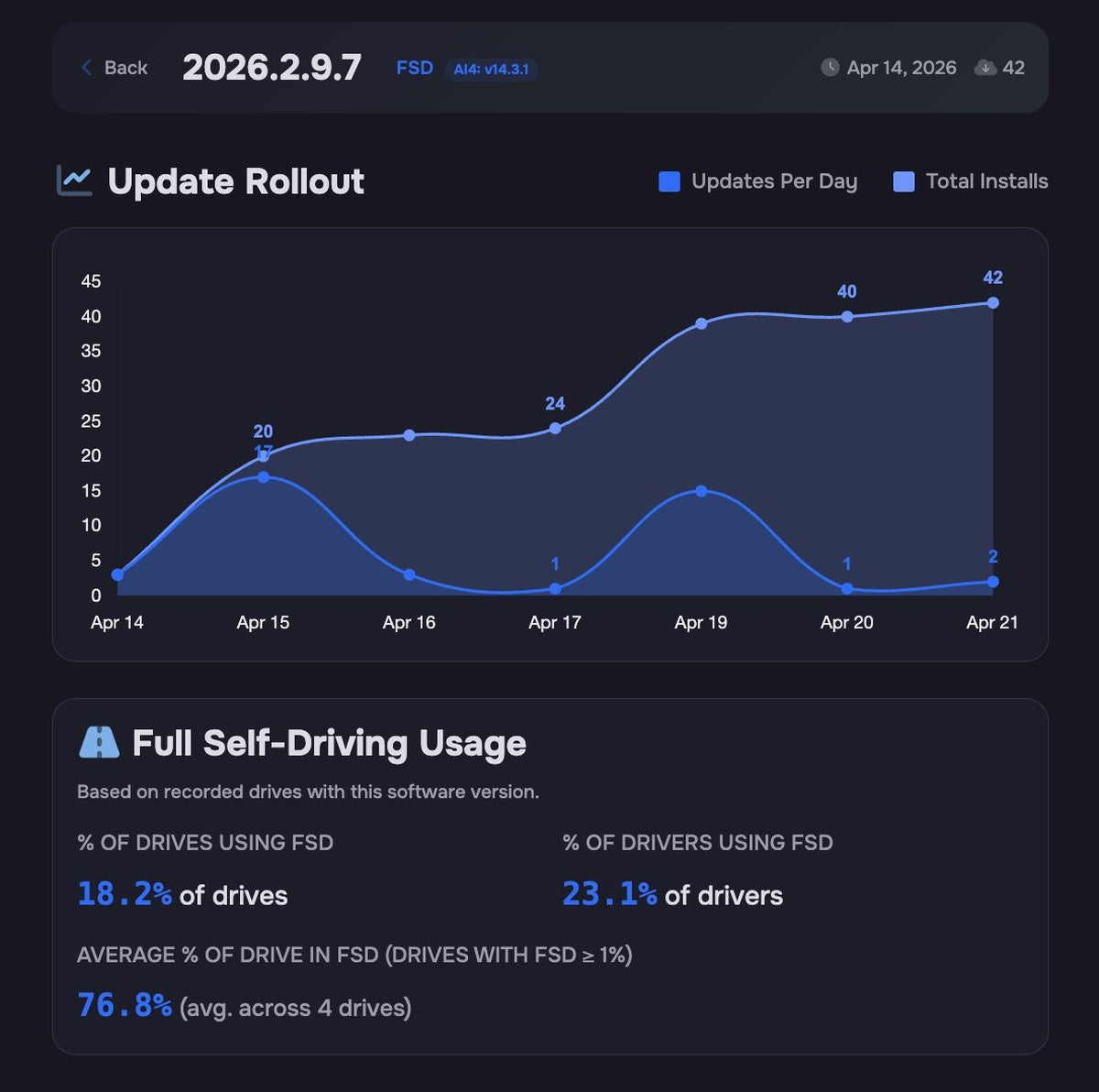
The News: Teslascope has launched a publicly accessible FSD performance metrics dashboard, covering V14.3.1 and future builds — powered by real data from AI4-equipped vehicles.
Why It Matters: For the first time, any Tesla owner can see objective, crowd-sourced data on how FSD is actually performing in the real world — not just Tesla's internal claims.
Source: @teslascope on X
Teslascope Launches Public FSD Performance Metrics Dashboard — V14.3.1 Now Trackable
If you've ever wondered how Tesla's Full Self-Driving software is actually performing across the fleet — not in a press release, not in a curated demo — Teslascope just answered that question. The platform officially launched a publicly accessible FSD metrics dashboard today, giving any Tesla owner a window into real-world performance data sourced from AI4-equipped vehicles.

📊 What the Dashboard Tracks
The new public dashboard surfaces three core metrics for each FSD software version:
| Metric | What It Shows | Why It Matters |
|---|---|---|
| % of Drives Using FSD | How many total drives have FSD engaged at any point | Measures real-world adoption per software version |
| % of Drivers Using FSD | Share of the AI4 fleet actively engaging FSD | Reveals whether owners actually trust a given build |
| Avg % of Drive Completed in FSD | How much of each trip runs on FSD without intervention | The clearest proxy for real-world capability improvement |
The current spotlight is on FSD V14.3.1, first noticed on April 14, 2026 — a point release building on V14.3, which itself brought significant under-the-hood improvements including a rewritten AI compiler and runtime using MLIR, delivering a 20% faster reaction time according to verified reporting.

AI4 vs. HW3 — Why the Data Source Matters
Teslascope's dashboard is explicitly powered by AI4-equipped vehicles — that's Model 3 Highland, Model Y Juniper, and other Tesla vehicles built from early 2023 onward with Hardware 4. This distinction is critical context for interpreting the numbers.
AI4 vehicles operate on a fundamentally different performance tier than older HW3 platforms. Data from FSD v13 in March 2026 illustrated the gap clearly: AI4 vehicles averaged 450 miles between critical disengagements, while HW3 platforms hovered around 120 miles. AI4 also benefits from an eight-fold increase in voxel resolution, enabling detection of fine details at twice the distance compared to HW3.
In short: the metrics Teslascope is publishing represent FSD at its current best. Owners on HW3 hardware should treat these numbers as a ceiling, not an expectation for their own experience.
🔭 The BASENOR Take
Timeline: Dashboard live as of April 21, 2026 — V14.3.1 data available now. Developer API access planned for a future update.
Impact Level: Medium-High — changes how owners and analysts evaluate FSD progress
Confidence: High — sourced directly from Teslascope's official announcement
This launch is quietly significant. Until now, the only FSD performance data available to the public came from Tesla's own safety reports (published quarterly, heavily aggregated) or anecdotal owner accounts. Teslascope's dashboard introduces something different: version-by-version, real-time fleet data that tracks whether each OTA update actually moves the needle on driver trust and system capability.
The metric to watch most closely is the average percentage of a drive completed in FSD. It's a direct behavioral signal — if owners are letting FSD run longer without intervening, that's confidence being earned in the real world, not in a test environment. As V14.3.1 data accumulates, this number will become one of the most honest scorecards for FSD's trajectory.
Teslascope has also signaled that the platform will evolve — specifically, that these metrics will eventually be available via Developer APIs. That opens the door for third-party researchers, journalists, and even Tesla itself to build on top of this data layer. The community has long wanted an independent, transparent FSD performance benchmark. This is the closest thing to it that currently exists.
Worth noting: Tesla also introduced its own in-app FSD statistics screen around April 15, 2026 — showing self-driving distance, overall distance, and daily usage streaks for individual drivers. The two tools serve different purposes. Tesla's screen is personal; Teslascope's dashboard is fleet-wide and version-specific. Together, they give owners both a micro and macro view of FSD performance — a combination that didn't exist a month ago.
For owners following our FSD coverage, this dashboard is worth bookmarking. Every time Tesla pushes a new FSD build, you'll now have a data-backed way to assess whether it's worth enabling on your next drive.
📰 Deep Dive
The timing of this launch is no accident. FSD V14.3 represented one of the more substantial architectural shifts in recent memory — the MLIR-based compiler rewrite wasn't a surface-level feature addition, it was a foundational change to how FSD processes and reacts to the world. Teslascope's public metrics will now let the community verify whether that 20% reaction time improvement translates into measurable real-world behavior changes, specifically in how long drivers are willing to leave FSD engaged.
There's also a credibility angle here. Tesla's autonomous driving narrative has historically been difficult to verify independently. Teslascope — which aggregates opt-in data from its subscriber base — can't claim to represent the entire Tesla fleet, but it can offer a consistent, methodology-stable benchmark that compounds in value over time. The more software versions get tracked, the more meaningful the longitudinal comparisons become. A year from now, this dataset could be genuinely illuminating.
The planned Developer API access is the detail most worth watching. If Teslascope opens this data to external developers, it could seed an ecosystem of FSD analysis tools — safety researchers, academic institutions, and independent journalists could all build on top of a shared, community-sourced dataset. That's a meaningful step toward the kind of third-party accountability that autonomous driving technology will increasingly need as it matures.
📋 Tracking Tesla software? See every firmware, FSD and app version in one place in our Tesla Software Update Tracker.
Related Gear
Gear up your Tesla with tested, custom-fit BASENOR accessories — shop Tesla accessories →
Sources & reporting notes
The links below identify the material source records used for this report.
- @teslascope on X (2026-04-21T23:21:24.000Z) — Direct source
- @teslascope on X (2026-04-21T23:20:27.000Z) — Direct source
Source links are preserved as published or accessed. See our editorial standards and corrections policy.
The BASENOR Editorial Desk covers Tesla, SpaceX, and related technology, curating reporting from primary sources — official accounts, regulatory filings, and software release data. Every article passes source-record and fact-checking review before publication. About the newsroom.
This report was curated by the BASENOR Editorial Desk from the sources listed above. Read our editorial standards or email editorial@basenor.com to report an error.