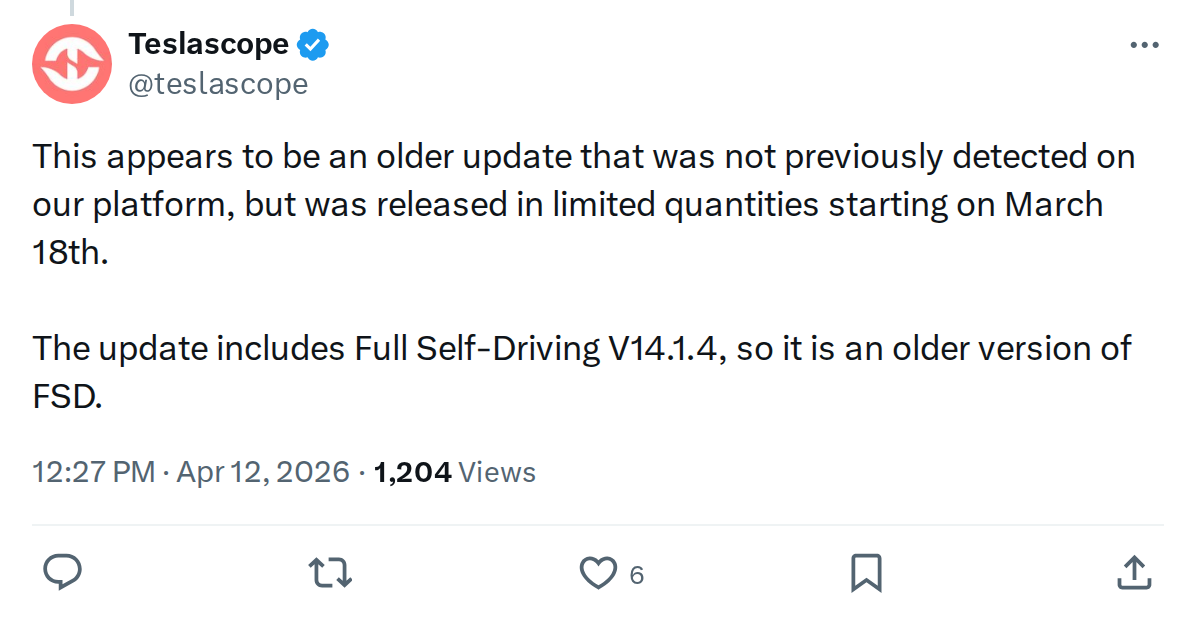
The News: Teslascope has detected Tesla FSD V14.1.4 circulating in a limited rollout that quietly began on March 18, 2026 — a version that flew under the radar of automated tracking platforms until now.
Why It Matters: If you own a Hardware 4 vehicle and haven't received a recent FSD update, this older build may be what lands in your queue — and it carries a meaningful set of improvements worth knowing about.
Source: @teslascope on X
Tesla FSD V14.1.4 Surfaces in Delayed Rollout: What Owners Need to Know
Tesla's FSD rollout cadence has never been perfectly linear, and this week's discovery from Teslascope is a textbook example of why tracking these updates is harder than it looks. The fleet monitoring platform has identified FSD V14.1.4 actively reaching vehicles — despite the fact that this version began its limited distribution all the way back on March 18, 2026, and was never logged on their platform during that initial push.

The gap between when V14.1.4 first shipped and when it was detected publicly is notable. It suggests Tesla distributed this build to a very narrow slice of the fleet — likely a targeted group of vehicles or a specific hardware configuration — before any monitoring tools picked it up. By the time Teslascope flagged it, FSD V14.2.2.5 had already been the current production version for weeks.
📊 What's Actually in FSD V14.1.4
Despite being an older build relative to today's production version, V14.1.4 was a substantive update when it originally rolled out widely to Hardware 4 vehicles in late October 2025. Here's a full breakdown of what it brought to the table:
| Change | Type | Category |
|---|---|---|
| Arrival Options (Parking Lot, Street, Driveway, Garage, Curbside) | Official | Navigation |
| Emergency vehicle pull-over and yield handling | Official | Safety |
| Vision-based routing for blocked roads and detours | Official | Navigation |
| New SLOTH speed profile (5 total: Sloth, Chill, Standard, Hurry, Mad Max) | Official | Driving Behavior |
| Scroll wheel now adjusts Speed Profile (not mph offset) | Official | UX / Controls |
| Improved static and dynamic gate handling | Official | Obstacle Handling |
| Improved road debris offsetting (tires, branches, boxes) | Official | Obstacle Handling |
| Improved unprotected turns, lane changes, cut-ins, school buses | Official | Driving Behavior |
| System fault management and degraded-mode recovery | Official | Reliability |
| Alert for interior windshield residue affecting front camera | Official | Maintenance |
| Automatic narrow-field front camera self-cleaning wash | Official | Hardware Integration |
| Significantly reduced phantom braking | 🔍 User-Reported | Driving Behavior |
| Noticeably smoother cornering and speed maintenance | 🔍 User-Reported | Driving Behavior |
🔭 The BASENOR Take
Timeline: V14.1.4 first distributed March 18, 2026 → detected by Teslascope April 12, 2026 (25 days untracked)
Current Production Version: FSD V14.2.2.5 (as of mid-March 2026)
Impact Level: Low-to-Medium — affects a small subset of the fleet, but meaningful for those receiving it
Confidence: High — confirmed by Teslascope fleet monitoring; release notes verified
The most interesting question here isn't what V14.1.4 contains — it's why Tesla is still pushing it to a subset of vehicles nearly three months after its wide rollout and weeks after V14.2.2.5 became the standard production build.
A few plausible explanations: Tesla may be using this limited distribution to catch up specific vehicle configurations that were skipped during the original October rollout — perhaps vehicles that were offline, in service, or flagged for a different software branch. It's also possible this represents a deliberate staged approach for certain hardware revisions or regional markets that weren't part of the initial HW4 push.
What it almost certainly isn't: a regression or downgrade. Tesla doesn't push older FSD builds as replacements for newer ones. The vehicles receiving V14.1.4 right now are most likely getting their first taste of the v14 generation — not being rolled back from something newer.
For owners on the receiving end of this update, the practical upside is real. The five-speed-profile system (Sloth through Mad Max), the Arrival Options parking selector, and the emergency vehicle handling are all genuinely useful additions. User reports from the original October rollout were among the most positive the FSD community had seen in years — phantom braking reductions and smoother cornering were consistently highlighted. Check out our FSD coverage for the full history of what each version has brought to the table.
The bigger picture: Teslascope's detection gap highlights just how fragmented Tesla's OTA distribution can be. A version can be actively shipping to real vehicles for weeks without appearing in any public tracking data. If you're monitoring your software version manually through your vehicle's settings, this is a reminder that the official version string is always the ground truth — fleet trackers, however good, will occasionally miss narrow distributions like this one.
📋 Tracking Tesla software? See every firmware, FSD and app version in one place in our Tesla Software Update Tracker.
Related Gear
Gear up your Tesla with tested, custom-fit BASENOR accessories — shop Tesla accessories →
Sources & reporting notes
The links below identify the material source records used for this report.
- @teslascope on X (2026-04-12T04:27:11.000Z) — Direct source
Source links are preserved as published or accessed. See our editorial standards and corrections policy.
The BASENOR Editorial Desk covers Tesla, SpaceX, and related technology, curating reporting from primary sources — official accounts, regulatory filings, and software release data. Every article passes source-record and fact-checking review before publication. About the newsroom.
This report was curated by the BASENOR Editorial Desk from the sources listed above. Read our editorial standards or email editorial@basenor.com to report an error.