30-Second Brief
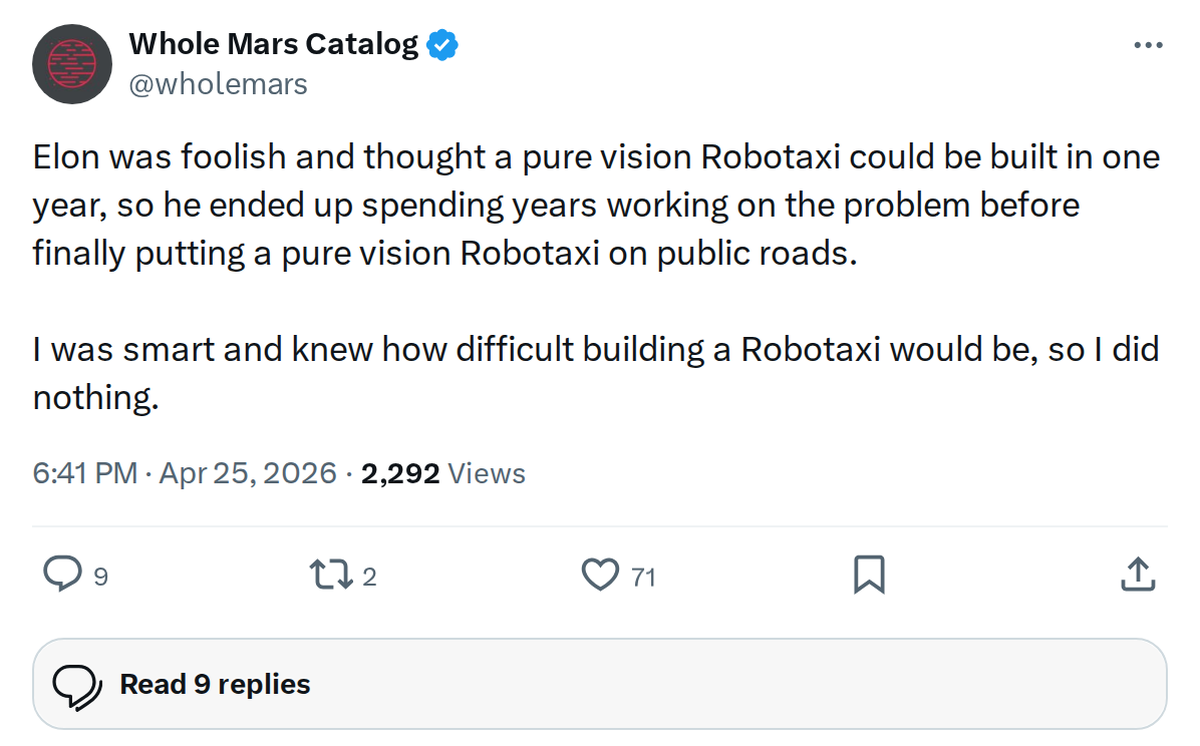
The News: A viral post from Whole Mars Catalog captures the arc of Tesla's Robotaxi journey — Elon Musk's early optimism about a one-year timeline gave way to years of grinding technical work, ultimately delivering a pure vision Robotaxi operating on public roads.
Why It Matters: For Tesla owners, this milestone validates the pure vision approach underpinning every FSD-equipped vehicle on the road today — your car runs on the same foundational technology now powering driverless rides in Austin, Dallas, and Houston.
Source: @wholemars on X
Tesla's Pure Vision Robotaxi: From Impossible Dream to Public Roads
The story of how stubborn ambition — and years of hard technical work — beat comfortable skepticism.

There is a particular kind of post that cuts through the noise — not because it carries breaking data or a leaked spec sheet, but because it nails an uncomfortable truth in two sentences. Whole Mars Catalog's April 25 observation does exactly that. Elon Musk was wrong about the timeline. He was right about everything else.
The post is deliberately self-deprecating on behalf of the skeptics: the person who knew how hard the problem was and therefore did nothing. It is a sharp reminder that knowing something is difficult is not the same as solving it. Tesla chose to attempt the harder path — cameras only, no LiDAR crutch, no radar safety net — and spent years proving it could work. Now a pure vision Robotaxi is operating on public roads. The skeptics are still watching.
📊 The Robotaxi Timeline: From Bold Claim to Driverless Reality
| Date | Milestone |
|---|---|
| Oct 2024 | Cybercab unveiled — purpose-built driverless vehicle, no pedals, no steering wheel, priced under $30,000 |
| Jun 22, 2025 | Robotaxi service launches in Austin, TX — limited capacity with human safety monitors aboard |
| Sep 2025 | Tesla Robotaxi app launches on iOS |
| Jan 22, 2026 | Unsupervised (driverless) Robotaxi rides begin integrating into the Austin fleet |
| Apr 2026 | Cybercab production begins at Gigafactory Texas; Robotaxi Android app launches; service expands to Dallas and Houston |
| H1 2026 | Confirmed expansion to Phoenix, Miami, Orlando, Tampa, and Las Vegas |
Why Pure Vision Is a Bigger Deal Than It Sounds
When Musk committed to a camera-only approach, the autonomous vehicle industry treated it as recklessness. The prevailing wisdom held that LiDAR — expensive, bulky, and sensor-heavy — was non-negotiable for safe autonomy. Tesla disagreed and bet the entire FSD program on vision alone.
The system deployed in today's Robotaxi fleet uses eight external cameras providing 360-degree visibility, processing an estimated 2 billion data points in real-time. There is no LiDAR. There is no radar. The same architecture runs on every FSD-equipped Tesla currently on public roads — which means every mile driven by the Robotaxi fleet is also refining the system in your own car.
According to Tesla, FSD (Supervised) already demonstrates 7 times fewer major and minor collisions compared to average human driving, and 5 times fewer off-highway collisions. The Robotaxi program is the live-fire test of whether that performance holds at scale, without a human ready to intervene.
🔭 The BASENOR Take
The Whole Mars Catalog post is funny because it is true — and uncomfortable for anyone who spent years confidently explaining why Tesla's approach would fail. The irony is that the critics were not wrong about the difficulty. They were wrong about what difficulty implies.
Musk's original timeline was off. Significantly. But the direction was correct. Tesla built a data flywheel — millions of FSD miles driven by real owners in real conditions — that no LiDAR-equipped competitor could replicate without a similarly massive fleet. The timeline slippage was the cost of doing something genuinely novel at scale.
For owners, the practical implication is straightforward: the Robotaxi expansion to seven U.S. cities in H1 2026 is not a separate product from your FSD subscription. It is the same system, stress-tested in commercial driverless operation, with every improvement feeding back into your vehicle's next software update. The Robotaxi fleet is, in effect, the world's largest real-world FSD test bench — and you are already part of it.
📰 Deep Dive
The Whole Mars Catalog post captures something that raw milestone announcements often miss: the human cost of ambitious timelines. Musk has been publicly optimistic about Robotaxi deployment dates for years, and those timelines repeatedly slipped. That history was used as evidence that pure vision autonomy was fundamentally flawed, rather than simply hard. The distinction matters enormously.
What actually happened is that Tesla kept building. FSD version after FSD version, each one incrementally more capable. Hardware 4 rolled out across the new vehicle lineup. FSD v14.2 introduced a higher-resolution neural network vision encoder. The Austin launch in June 2025 started with safety monitors — an honest acknowledgment of where the system stood. By January 2026, those monitors were gone from a portion of the fleet. By April 2026, the service had crossed state lines into Dallas and Houston, with five more cities confirmed for the first half of the year.
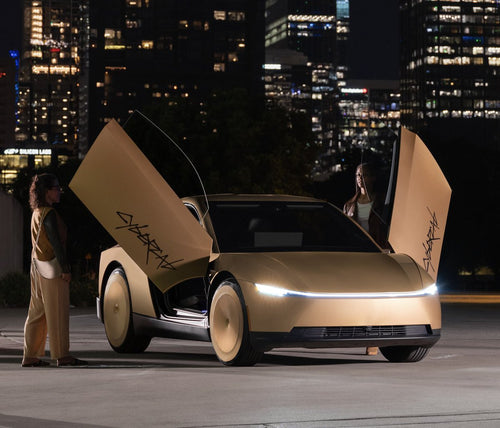
The Cybercab adds another dimension. A purpose-built vehicle with no steering wheel and no pedals is not a hedge — it is a declaration that Tesla considers the driverless problem solved enough to design hardware around it. Production at Gigafactory Texas beginning this month, at a target price under $30,000, suggests Tesla intends to make autonomous transport economically accessible rather than a premium novelty.
The broader lesson from the @wholemars post is one that applies well beyond Tesla: the gap between knowing something is hard and actually attempting it is where most progress dies. Elon Musk was wrong about how long it would take. He was right that it was worth trying. That distinction is now operating on public roads in Texas — and heading to six more cities before summer. For owners following our FSD coverage, the pace of deployment in 2026 suggests the gap between supervised and fully autonomous operation is closing faster than most expected.
📋 Tracking Tesla software? See every firmware, FSD and app version in one place in our Tesla Software Update Tracker.
🚕 Following the Robotaxi rollout? See every operating city, launch date and announced market in our Tesla Robotaxi Tracker.
Related Gear
Gear up your Tesla with tested, custom-fit BASENOR accessories — shop Tesla accessories →
Sources & reporting notes
The links below identify the material source records used for this report.
- @wholemars on X (2026-04-25T10:41:38.000Z) — Direct source
Source links are preserved as published or accessed. See our editorial standards and corrections policy.
The BASENOR Editorial Desk covers Tesla, SpaceX, and related technology, curating reporting from primary sources — official accounts, regulatory filings, and software release data. Every article passes source-record and fact-checking review before publication. About the newsroom.
This report was curated by the BASENOR Editorial Desk from the sources listed above. Read our editorial standards or email editorial@basenor.com to report an error.