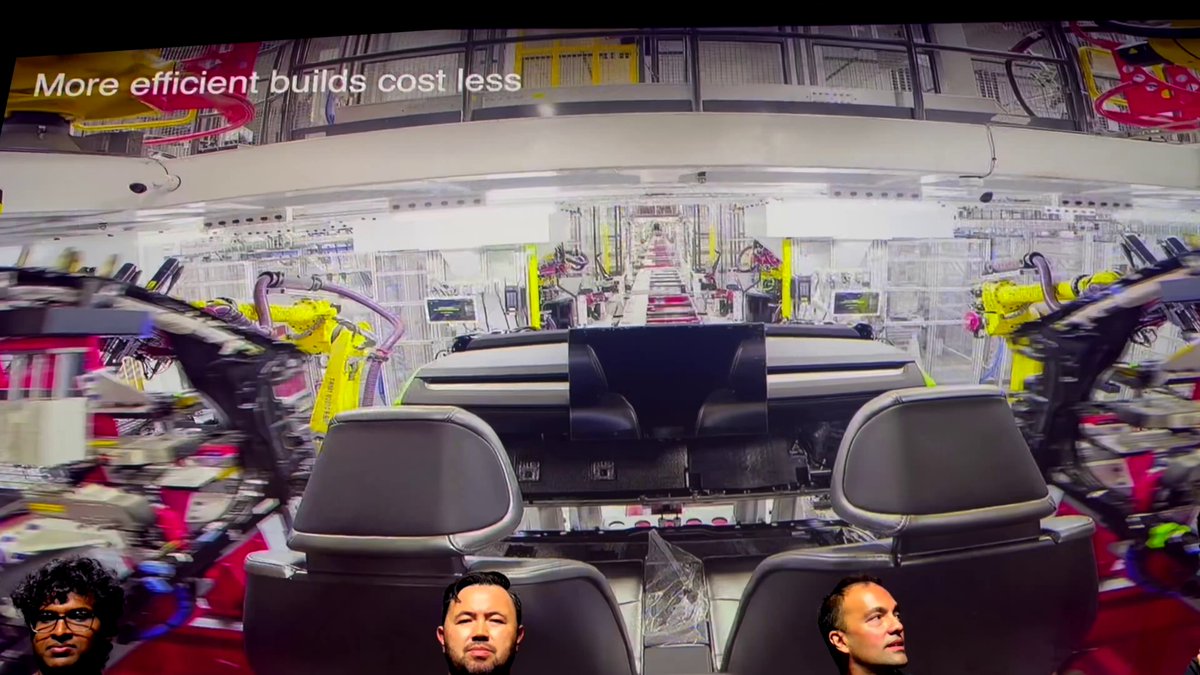
Tesla has released fresh footage of the 'unboxed' manufacturing process powering its Cybercab robotaxi, giving the clearest public look yet at a production system the company claims can roll one vehicle off the line in under 10 seconds — with a long-term theoretical cycle time of just 5 seconds. For context, a traditional automotive final assembly line typically operates on cycle times of roughly 30-60 seconds per unit.
The video, shared by @SawyerMerritt from the launch event, shows modules moving through parallel assembly stations rather than the familiar linear conveyor of a conventional car plant. It is the manufacturing philosophy Tesla first previewed at its 2023 Investor Day, now visibly operational at Gigafactory Texas.

What the 'Unboxed' Process Actually Is
Unlike a traditional linear assembly line — where a body-in-white travels through paint, then trim, then final assembly in sequence — the unboxed method breaks the vehicle into five or six major modules that are built in parallel and joined at the very end.
According to Tesla's Investor Day presentation and subsequent reporting from Forbes and Teslarati, those modules are:
- Front end structure
- Rear end structure
- Left side assembly
- Right side assembly
- Structural battery pack (which doubles as the vehicle's floor and includes seats and interior trim installed before joining)
Each module gets painted separately — a critical shift, because paint shops are traditionally the slowest and most capital-intensive part of a car factory. The modules are then brought together in a final station using robots, lasers, and minimal adhesive to form a completed vehicle. Tesla has publicly stated the approach reduces factory footprint by roughly 40% and labor costs by about 30% versus traditional linear assembly.
Key Figures
| Metric | Cybercab (Unboxed) | Traditional Line (reference) |
|---|---|---|
| Cycle time (near-term) | Under 10 seconds | ~30-60 seconds |
| Cycle time (long-term goal) | 5 seconds | N/A |
| Factory footprint | ~40% smaller | Baseline |
| Labor cost | ~30% lower | Baseline |
| Projected annual capacity | 2M-3M units (up to 5M at 5s cycle) | — |
Figures per Tesla's Investor Day disclosures and reporting from Forbes, Teslarati, and CleanTechnica. Long-term cycle time is a stated goal, not current output.
How We Got Here
The Cybercab's manufacturing story has moved faster than most observers expected. According to Teslarati, the first production Cybercab rolled off the line at Gigafactory Texas on February 17, 2026, with formal mass production kicking off in April 2026. By late March, roughly 36 production-intent units had been photographed at the facility, and CleanTechnica reported at least 60 units on site by mid-April.

What the new footage reveals is that the line Tesla was building through 2024 and 2025 is now visibly running the parallel-module workflow the company promised. It also underscores why Tesla designed the Cybercab as a two-seat, steering-wheel-free vehicle from a blank sheet: the unboxed method requires a design tailored to modular assembly, not retrofitted onto an existing platform.
Why the Cycle-Time Numbers Are Aggressive
Cycle time — the interval between finished vehicles rolling off the end of the line — is one of the most watched metrics in auto manufacturing. Highly optimized traditional plants (Toyota's best facilities, for example) operate around 30-60 seconds per vehicle. Tesla's own Model Y line at Gigafactory Shanghai has been reported at roughly 35-40 seconds.
A sub-10-second target represents a roughly 3-4x throughput improvement per line. If Tesla hits its 5-second long-term goal, the comparison starts to look less like automotive assembly and more like consumer electronics — which is exactly the framing Tesla has used in investor communications. Multiple reports have described the Cybercab process as closer to smartphone assembly than car manufacturing in its cadence and layout.
Whether Tesla actually achieves sustained sub-10-second output at scale remains the open question. Production ramps are historically the hardest part of new vehicle programs, and the Cybercab program is compounded by regulatory questions about deploying a vehicle with no manual controls in every U.S. jurisdiction. Musk himself has said the 5-second figure is a long-term theoretical goal, not a near-term target.
What This Means for Tesla's Broader Roadmap
The unboxed process isn't just about the Cybercab. Tesla has signaled in multiple earnings calls that elements of the method will migrate to future vehicles — potentially including the next-generation affordable platform. If the approach delivers even a fraction of the promised efficiency gains, it becomes a durable cost advantage that's difficult for legacy automakers to replicate without rebuilding factories from scratch.
For existing Tesla owners, the near-term impact is indirect but real: a lower-cost, high-volume Cybercab feeds directly into the robotaxi network economics that underpin Tesla's autonomy strategy. The more Cybercabs Tesla can produce per hour, the faster the network scales — and the faster owner-facing features tied to that network (ride-hailing, fleet participation) can mature.
What to Watch Next
- Sustained cycle-time disclosures — Tesla has not yet publicly confirmed the current real-world cycle time at Gigafactory Texas. Watch for numbers in the next quarterly update.
- Second production line — Whether Tesla replicates the unboxed line at other facilities, and how quickly.
- Paid ride availability — The commercial robotaxi rollout timing is tied directly to production ramp.
- Regulatory clearance — NHTSA and state-level approval for a vehicle with no steering wheel remains an open variable.
The video from the launch event confirms the manufacturing thesis Tesla has been selling for three years is now hardware, not slideware. Execution — the gap between a demo line and 2-3 million units a year — is the story from here.
🚕 Following the Robotaxi rollout? See every operating city, launch date and announced market in our Tesla Robotaxi Tracker.
Related Gear
Gear up your Tesla with tested, custom-fit BASENOR accessories — shop Tesla accessories →
Sources & reporting notes
The links below identify the material source records used for this report.
- @SawyerMerritt on X (2026-09-07T15:16:10.000Z) — Direct source
- @SawyerMerritt on X (2026-09-07T15:35:34.000Z) — Direct source
Source links are preserved as published or accessed. See our editorial standards and corrections policy.
The BASENOR Editorial Desk covers Tesla, SpaceX, and related technology, curating reporting from primary sources — official accounts, regulatory filings, and software release data. Every article passes source-record and fact-checking review before publication. About the newsroom.
This report was curated by the BASENOR Editorial Desk from the sources listed above. Read our editorial standards or email editorial@basenor.com to report an error.