
SpaceX completed another classified Space Force delivery on November 24, lifting off from Vandenberg Space Force Base at 16:08 UTC with the USSF-266 mission — publicly tracked as SBST TH-3, the third in a rapid series of Space Based Sensing and Targeting launches. The mission marks SpaceX's fifth government launch in November alone, underscoring how deeply embedded the company has become in the U.S. national security launch cadence.

The TH Series Is Moving Fast
SBST TH-3 is the third mission under a "TH" designation tied to the Space Force's Space Based Sensing and Targeting portfolio. According to Spaceflight Now, the cadence has been striking: TH-1 (USSF-259) launched September 16, TH-2 (USSF-481) followed on October 15, and now TH-3 (USSF-266) on November 24. That's three classified national security payloads delivered in roughly ten weeks.
These missions are believed to be part of a $1.6 billion task order awarded to SpaceX for 18 Falcon 9 launches under the National Security Space Launch (NSSL) Phase 3 Lane 1 contract, with the full series expected to conclude by end of 2027. The Space Force has not disclosed the specific payloads, but the SBST portfolio broadly covers satellite-based sensing and targeting capabilities for the U.S. military.
Separately, the Space Force's SBST division awarded SpaceX a $4.16 billion Other Transaction Authority agreement in May 2026 for the Space-Based Airborne Moving Target Indicator (SB-AMTI) program — a next-generation global tracking system. The TH launches are distinct from that program but reflect the same strategic push to rapidly expand space-based sensing infrastructure.
Booster B1081: 29 Flights and Counting
The first-stage booster on this mission, B1081, flew for the 29th time — a figure that would have seemed implausible for a rocket booster just a decade ago. After separation, it landed on the droneship Of Course I Still Love You in the Pacific Ocean approximately 8.5 minutes after liftoff. According to Spaceflight Now, this was the 236th landing on that particular vessel and the 681st booster landing in SpaceX history.
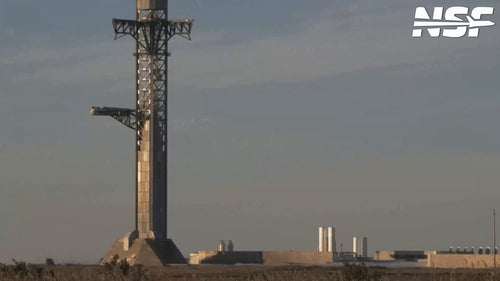
That reusability record matters beyond the headline number. Each reflown booster on a government contract represents a direct cost reduction for the Space Force — and it's part of why SpaceX continues to win large NSSL task orders at the pace it does. The NROL-136 mission just two days earlier set a Vandenberg turnaround record, and USSF-317 was in propellant load just days before that — the SLC-4E pad at Vandenberg is effectively running like a production line.
November's Government Launch Surge
| Mission | Customer | Date (Nov 2026) |
|---|---|---|
| USSF-317 | Space Force | Nov 21 |
| NROL-136 | NRO | Nov 22 |
| USSF-266 (SBST TH-3) | Space Force | Nov 24 |
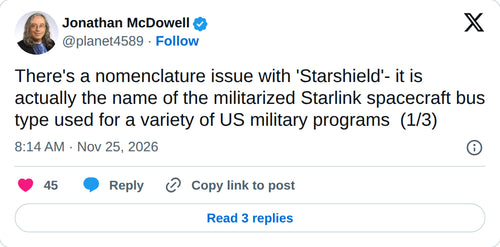
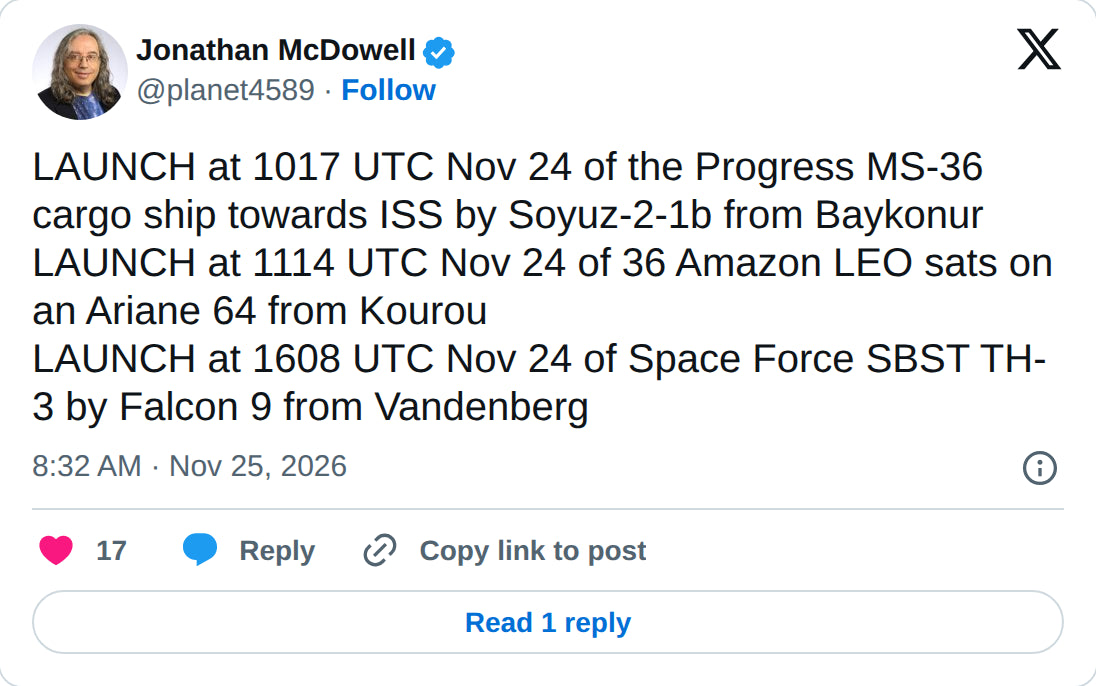
Jonathan McDowell's launch log for November 24 alone captures three separate orbital missions — a Soyuz cargo run to the ISS, an Ariane 64 carrying 36 Amazon LEO satellites, and the Falcon 9 SBST TH-3 — a reminder of how routine high-cadence orbital access has become. For SpaceX specifically, the government manifest is not slowing down: Northrop Grumman's latest Cygnus contract adds another commercial government mission to the Falcon 9 queue, and the remaining TH-series launches still need to be completed before the end of 2027.
With 15 more missions left in the SBST task order and the SB-AMTI program still in early development, SpaceX's national security pipeline looks fully loaded well into next year. Whether the TH series maintains its roughly monthly cadence through 2027 will be one of the cleaner indicators of how well the NSSL Phase 3 Lane 1 contract is actually performing against schedule.
Sources & reporting notes
The links below identify the material source records used for this report.
- @planet4589 on X (2026-11-25T00:32:31.000Z) — Direct source
Source links are preserved as published or accessed. See our editorial standards and corrections policy.
The BASENOR Editorial Desk covers Tesla, SpaceX, and related technology, curating reporting from primary sources — official accounts, regulatory filings, and software release data. Every article passes source-record and fact-checking review before publication. About the newsroom.
This report was curated by the BASENOR Editorial Desk from the sources listed above. Read our editorial standards or email editorial@basenor.com to report an error.