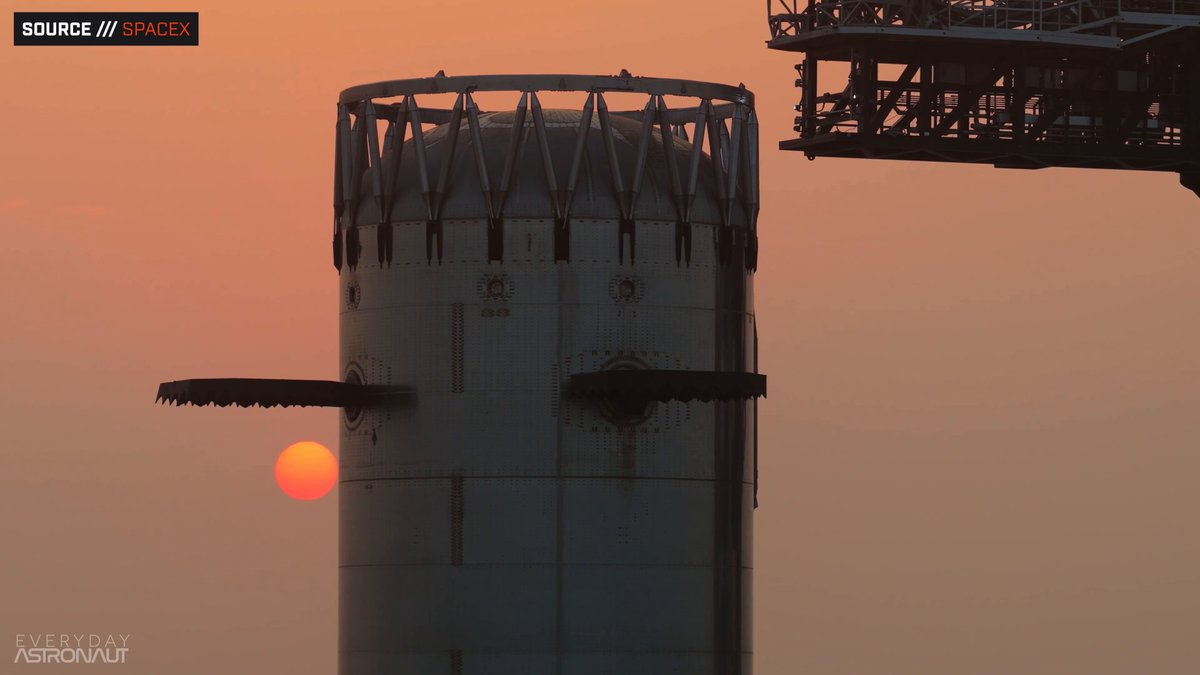
SpaceX's V3 Super Heavy Booster is flying with one fewer grid fin than its predecessors — and that's entirely intentional. Everyday Astronaut's deep dive into the change explains why removing a component can sometimes be the most sophisticated engineering move of all, a direct expression of the "best part is no part" philosophy that runs through SpaceX's design culture.

Why did SpaceX go from four grid fins to three?
The shift from four to three grid fins on the V3 Super Heavy — officially introduced with Starship V3 on May 12, 2026 — is a deliberate mass and drag reduction. Four symmetrically placed fins create redundancy, but they also add inertia, aerodynamic drag at supersonic speeds, and mechanical complexity. By removing one fin and enlarging the remaining three by 50%, SpaceX gets the same — arguably better — control authority with fewer failure points. According to SpaceX's "Super Heavy V3 Change Highlights" released August 6, 2026, the redesign is expected to maintain the same overall weight as the prior generation despite the larger fin size, thanks to optimized stainless steel construction.
How does three fins give you better control than four?
Counter-intuitively, fewer fins can mean more responsive control. With four fins, the system carries more rotational inertia — the booster resists changes in attitude and takes longer to respond to actuator commands. Three larger fins reduce that inertia, which translates to faster response, less overshoot, and tighter controllability during the critical final seconds of descent. That precision matters most when the booster is aligning for a catch by the Mechazilla tower arms, where small attitude errors compound quickly.
What else changed beyond the fin count?
Quite a lot. The three fins are arranged in a 90/90/180-degree configuration rather than the evenly spaced 90-degree spacing of a four-fin layout. They've been repositioned lower on the booster to reduce heat exposure from Starship's engines during hot-staging. Each fin now incorporates a new catch point, and the entire assembly has been re-clocked on the booster to support both vehicle lift and catch operations by the launch tower. Perhaps most significantly, the grid fin shaft, actuator, and fixed structure have been moved inside the booster's main fuel tank — protecting critical actuation hardware from the thermal and mechanical environment outside the vehicle.
Are the fins foldable like previous versions?
No. The V3 grid fins are fixed, not foldable. Earlier Super Heavy designs used foldable fins partly to reduce the vehicle's footprint during stacking and transport. The V3 architecture, optimized around the Mechazilla catch-and-stack workflow, apparently no longer requires that feature — another example of removing complexity that the overall system design has made unnecessary.
What does "the best part is no part" actually mean in practice here?
The phrase, widely attributed to Elon Musk as a first-principles engineering heuristic, holds that the most reliable, lightest, and cheapest component is one that doesn't exist at all. Applied here: rather than engineering a fourth fin to be lighter or more heat-resistant, SpaceX asked whether the fourth fin needed to exist. The answer, after analyzing control requirements for the Mechazilla catch profile, was no — provided the remaining three fins were redesigned to compensate. The result is a booster that is simpler to manufacture, easier to actuate, and better suited to the steep descent angles required for a precision tower catch.
When did this design become public knowledge?
SpaceX shared photos of the redesigned grid fin on its X account around August 13–16, 2025, and published the formal "Super Heavy V3 Change Highlights" document on August 6, 2026. Everyday Astronaut's video, posted September 25, 2026, provides the most detailed public breakdown of the engineering rationale to date — including why the 90/90/180-degree fin arrangement works aerodynamically and how the internal actuator relocation changes the maintenance profile of the booster.
Whether the three-fin configuration becomes the permanent standard for Super Heavy or serves as a stepping stone to further simplification is an open question. SpaceX's track record suggests the answer depends entirely on what the flight data says — and the next Starship integrated flight test will be the first real-world validation of the redesign at full operational tempo. For more on Starship's development, see our SpaceX coverage.
🚀 Following the Starship program? See every test flight, official outcome and the next launch window in our SpaceX Starship Tracker.
Sources & reporting notes
The links below identify the material source records used for this report.
- @Erdayastronaut on X (2026-09-25T17:05:37.000Z) — Direct source
Source links are preserved as published or accessed. See our editorial standards and corrections policy.
The BASENOR Editorial Desk covers Tesla, SpaceX, and related technology, curating reporting from primary sources — official accounts, regulatory filings, and software release data. Every article passes source-record and fact-checking review before publication. About the newsroom.
This report was curated by the BASENOR Editorial Desk from the sources listed above. Read our editorial standards or email editorial@basenor.com to report an error.